


What Are the Best Lasers For Sunspots?
Overexposure to the sun’s harmful UV rays is a major cause of premature aging. Over time, unprotected sun exposure can accentuate fine lines and wrinkles, diminish skin elasticity, lead to dark spots, and even cause skin cancer. Dark spots caused by sun damage, also known as sun spots, age spots, solar lentigines, or liver spots, are typical signs of aging. These flat, brown spots usually appear on areas frequently exposed to the sun, such as the hands, shoulders, arms, and face. Age spots are very common and mostly affect people over 40. Unlike precancerous lesions, age spots are harmless. However, they can be upsetting signs of aging that may make people feel self-conscious, especially when hyperpigmentation appears on highly visible areas like the face, arms, chest, and hands. Luckily, Dr. Michele Green’s New York City dermatology office offers many treatments to lighten the skin and lessen the look of sun damage.
Dr. Green is an expert in a wide range of skin treatments for removing dark spots on the body. Some of the most effective options for reducing hyperpigmentation include laser treatments like the Fraxel laser, Clear + Brilliant Laser, Candela Alex-Trivantage laser, Picosecond lasers, and Intense Pulsed Light (IPL). These treatments are safe for patients of all skin tones and types, targeting hyperpigmentation without harming surrounding tissue. Laser treatments at Dr. Green’s office effectively remove unwanted pigment on the face and body with minimal downtime and no serious side effects. Dr. Green specializes in treating patients of all skin tones and types and recommends safe, effective skin rejuvenation and laser resurfacing options. To determine which laser is best for your specific skin concerns, schedule a consultation with expert dermatologist Dr. Michele Green.
Experienced, board-certified dermatologist Dr. Michele Green has been expertly treating patients at her Upper East Side, New York City, dermatology practice for over 25 years. In addition to treating age spots and hyperpigmentation, Dr. Green is skilled at addressing other signs of natural aging, such as fine lines, wrinkles, sagging skin, volume loss, and uneven skin tone and texture, with effective treatments like Botox, dermal fillers, laser procedures, microneedling, chemical peels, and more. Alongside anti-aging therapies, Dr. Green offers many options for treating dark spots, including those caused by skin cancer, melasma, and rosacea. Through her proprietary line of skincare products, MGSKINLABs, she can recommend top-quality topical lightening creams, lotions, cleansers, acne treatments, and sunscreens. Renowned for high patient satisfaction, Dr. Green has consistently been voted one of the best dermatologists in New York City by publications such as Castle Connolly, Super Doctors, and New York Magazine.
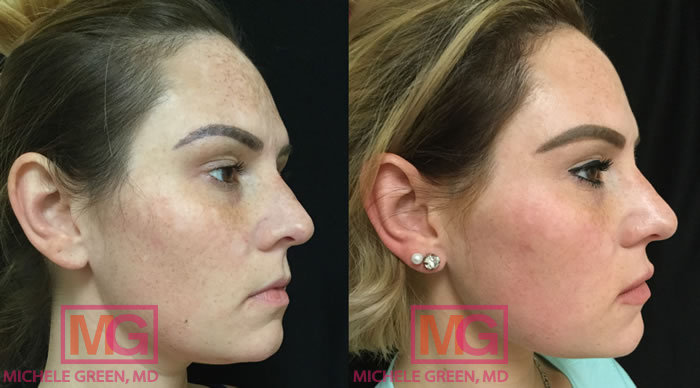
What are age spots? What does sun damage look like on the skin?
Age spots are areas of hyperpigmentation characterized by small brown or gray spots on the skin’s surface that can range in size from a freckle to half an inch or more. Often called liver spots, solar lentigines, or sunspots, these brown spots usually form due to unprotected exposure to harmful UV rays and are most commonly seen on the face, hands, arms, and neck. Age spots generally develop over time, typically appearing in middle age (40s-50s) as a result of sun damage sustained in youth. When UV rays from the sun or tanning beds hit unprotected skin, they stimulate the production of melanin, the pigment that helps protect the skin from harmful rays. However, this process can also cause dark spots or patches of hyperpigmentation, leading to a spotty, uneven look on the skin.
Are brown spots a sign of sun-damaged skin?
Dark spots develop on the skin’s surface due to repeated overexposure to the sun’s harmful UVA and UVB rays. Without adequate sun protection, UV rays can damage DNA in the skin. In response, the body increases melanin production to prevent this damage. Melanin, a pigment produced by melanocytes, gives skin its color. When the skin is exposed to the sun without sunscreen or other protection, the enzyme tyrosinase activates melanocytes in the exposed area, stimulating melanin production. This increased melanin helps absorb UV rays and protect the skin; however, it can also cause a dark spot in that area. The number of age spots and the degree of pigmentation depend on the cumulative amount of sun damage—the more frequent and intense the exposure, the greater the skin discoloration. Besides sun exposure, scarring, inflammation, and skin conditions such as melasma can also cause hyperpigmentation.
Can a dermatologist get rid of sunspots?
At Dr. Green’s cosmetic dermatology office on the Upper East Side of New York City, many options are available for removing sunspots. Dr. Green begins the treatment by examining the affected area and discussing your goals. Depending on the size and location of the sunspot, as well as the patient’s skin type and tone, Dr. Green will develop a personalized plan that is both safe and effective. Some patients may benefit most from laser treatments, often using the Candela Alex-Trivantage laser, Fraxel fractional laser resurfacing, or Intense Pulsed Light (IPL) to target sunspots. In other cases, Dr. Green may recommend chemical peels, which increase skin cell turnover and collagen production, resulting in smoother, brighter skin. Patients can also lighten dark spots at home with topical treatments included in their skincare routine, such as Vitamin C, retinoids, and exfoliants like kojic acid, azelaic acid, and glycolic acid. To avoid skin irritation, follow Dr. Green’s instructions on the best method to apply these topical treatments.
Can you laser away sunspots?
Several types of laser cosmetic treatments are available to remove sunspots from the skin’s surface, including fractional lasers like Fraxel, ablative lasers such as the CO2 laser, broad-spectrum light treatments like Intense Pulsed Light, and the Nd: YAG laser, such as the Alex-Trivantage laser. Each type of laser works differently to target pigmentation in the skin, but the overall principle is similar across all methods. Laser treatments cause controlled damage to the treated area, triggering the natural healing process, increasing skin cell turnover, and boosting collagen and elastin production for smoother, brighter, and more evenly textured skin.
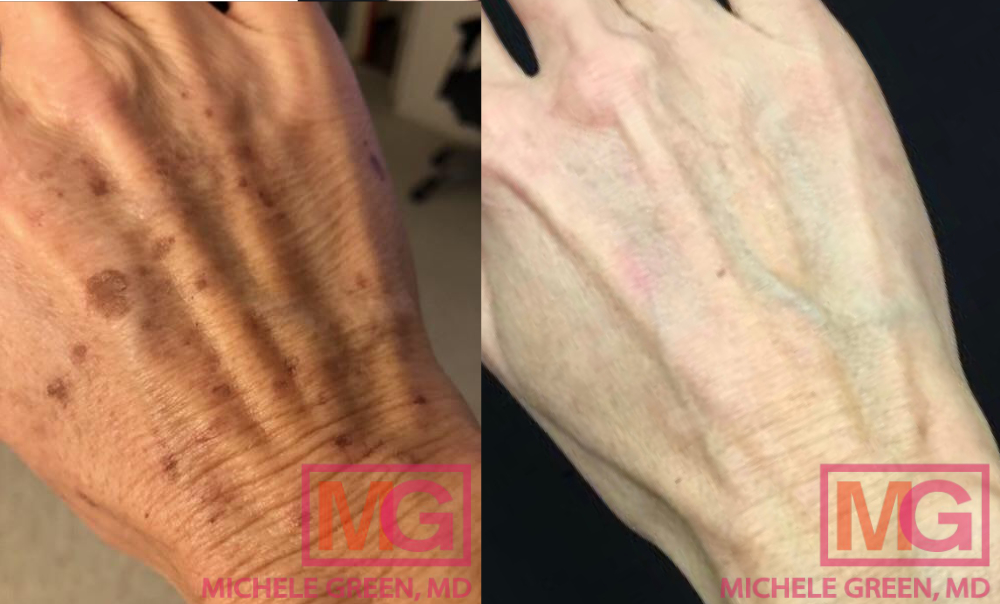
How do laser treatments for sunspots work?
The first step in laser treatment is to schedule a consultation with a board-certified dermatologist, Dr. Michele Green. During your consultation, Dr. Green will examine the affected area, and you will discuss your aesthetic goals before creating a personalized treatment plan. When you arrive for your laser therapy appointment, Dr. Green will start by cleaning the treatment area and providing you with protective eyewear. If you are receiving ablative laser treatment, an injectable pain medication may be given to minimize discomfort during the procedure. Dr. Green will then target the laser at the treatment area. Patients receiving non-ablative laser treatment may feel mild heating sensations followed by cooling, but most do not report significant discomfort. Non-ablative laser treatments for sunspots are beneficial because they deliver excellent results without downtime.
What is the aftercare post-treatment?
Following the procedure, Dr. Green’s office will guide patients on aftercare steps, which may differ depending on the type of laser used. After non-ablative laser treatment, patients might be advised to apply an ice pack to the treated area to reduce swelling, redness, and irritation. Also, patients will be instructed to avoid direct sunlight in the weeks after the procedure. To do this, Dr. Green recommends wearing sun-protective clothing, such as a wide-brimmed hat, and using SPF 30 or higher sunscreen whenever they go outside during the day. Patients who spend a lot of time outdoors should reapply sunscreen every 90 minutes.
Patients who undergo ablative laser treatment will need more detailed aftercare instructions. Since ablative laser creates an open wound, proper wound care is essential. A gentle, hydrating skincare routine is important to keep the skin clean and moisturized during healing. Patients should avoid harsh or exfoliating skincare products until the skin is fully healed and may need to take over-the-counter pain medication.
What type of laser is best for sunspots? What is the best laser for brown spots?
No one type of laser is inherently “best” for treating sunspots. Instead, it is important to select the laser treatment that best suits your individual needs. During your initial consultation with Dr. Green, she will examine the treatment area and discuss your aesthetic goals before recommending the most appropriate laser. Dr. Green has extensive experience treating patients of all skin types and carefully chooses laser treatments and settings for skin of color. Patients with darker skin are at a higher risk of experiencing serious side effects from certain laser treatments, such as hyperpigmentation, hypopigmentation, and keloid scarring. Dr. Green offers several laser options to safely and effectively treat patients with darker skin tones.
Does Fraxel laser get rid of sunspots?
Fraxel laser therapy is a non-ablative skin resurfacing cosmetic procedure approved by the FDA to treat various skin concerns, including acne scars, surgical scars, uneven skin texture, stretch marks, fine lines, brown spots, and sun damage. Originally developed by Solta Medical, the Fraxel laser is a fractional laser that uses precise beams of laser energy to target only a small area of the skin at a time, leaving the surrounding tissue unaffected. Fraxel is a non-ablative laser resurfacing option, meaning the treatment penetrates the dermis and encourages new collagen growth without vaporizing the outer layer of the skin. Consequently, Fraxel laser therapy can improve skin tone and texture, promoting healthy skin with minimal downtime.
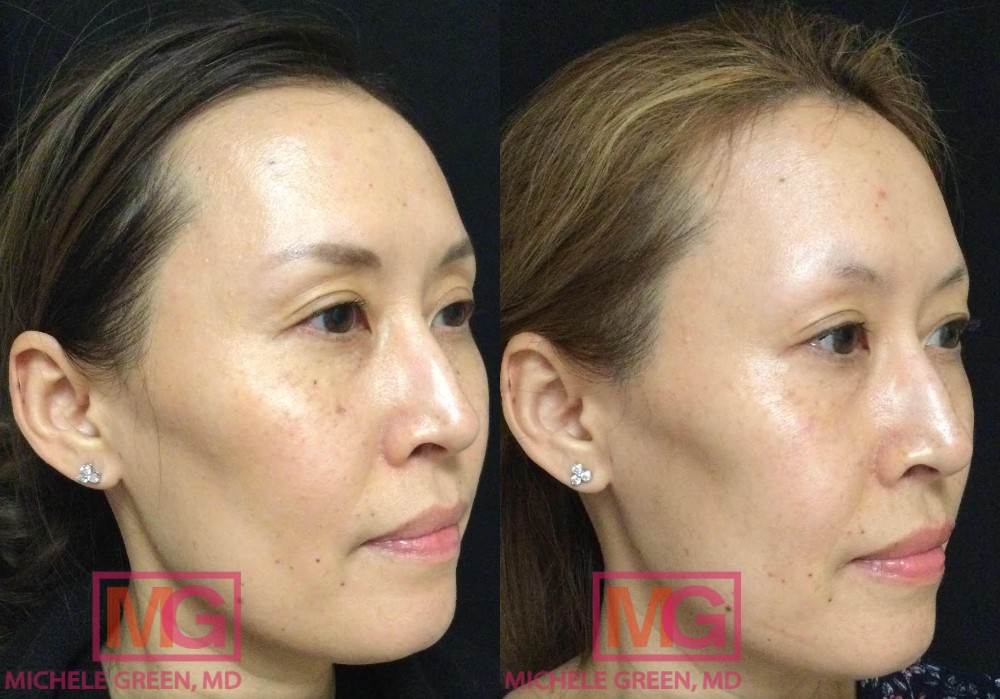
Fraxel laser treatment is highly effective at removing sun-damaged spots, freckles, uneven skin tone, and discoloration. Usually, Dr. Green uses the Fraxel Dual laser, a fractional device that delivers two light wavelengths: 1927 nm and 1550 nm. The 1550 nm wavelength (the Erbium laser) is best for treating fine lines, wrinkles, acne scars, and surgical scars, while the 1927 nm wavelength (the Thulium laser) is most effective for addressing pigmentation issues like sun damage. The Fraxel laser emits a column of fractionated light that targets specific skin areas, leaving surrounding cells and tissues unharmed. When using the Thulium laser (1927 nm), the light is absorbed by pigmented skin elements, converting into heat that causes controlled damage at the treatment site. These micro-wounds trigger increased collagen production, which helps improve skin tone and texture over time.
Which is better, Fraxel or CO2 laser for sunspots?
The Fraxel laser and the CO2 laser operate very differently in treating sunspots. While the Fraxel laser is non-ablative and works in a fractional manner, the CO2 laser is an ablative treatment that vaporizes the outer skin layer, the epidermis. This process boosts collagen production and accelerates skin cell renewal, leading to full facial rejuvenation. The CO2 laser emits a continuous-wave mid-infrared beam at 10,600 nanometers, making it one of the most powerful lasers. It can be used as an ablative laser for significant epidermal vaporization or as a fractional laser, which provides a gentler approach to facial rejuvenation. Ablative and fractional lasers, such as CO2, are safest in patients with Fitzpatrick skin types I or II, as darker skin tones are more prone to serious side effects, such as post-inflammatory hyperpigmentation or hypopigmentation. Patients with lighter skin tones seeking more dramatic results may opt for the CO2 laser. However, the CO2 laser carries a higher risk of side effects and requires a longer recovery period.
What is the strongest treatment for dark spots? Ablative laser treatment for sunspots
Ablative laser treatment for sunspots is the most powerful laser option for targeting sunspots on the skin’s surface. This procedure works by vaporizing the outer skin layer to trigger the body’s natural healing process, boosting collagen production and promoting skin cell turnover for brighter, smoother, and more evenly textured skin. Although ablative lasers produce more dramatic results than non-ablative lasers, they require a longer recovery time and carry a higher risk of serious side effects. Because of this, Dr. Green often prefers non-ablative lasers, such as the Fraxel laser, Alex-Trivantage and Clear + Birilliant lasers, which provide excellent results with no downtime.
Clear + Brilliant Laser for Sunspots
The Clear + Brilliant laser is often called a “mini-Fraxel” laser. It is a gentle laser resurfacing treatment approved by the FDA in 2011. Using fractionated laser technology, Clear + Brilliant creates millions of tiny treatment zones on the face, stimulates new collagen production, removes dead skin cells, and promotes healthy new skin growth. It effectively addresses sun damage, sunspots, uneven skin tone, discoloration, irregular texture, fine lines, and enlarged pores. Patients of all skin tones, including darker complexions, can benefit from Clear + Brilliant laser therapy for overall facial rejuvenation.
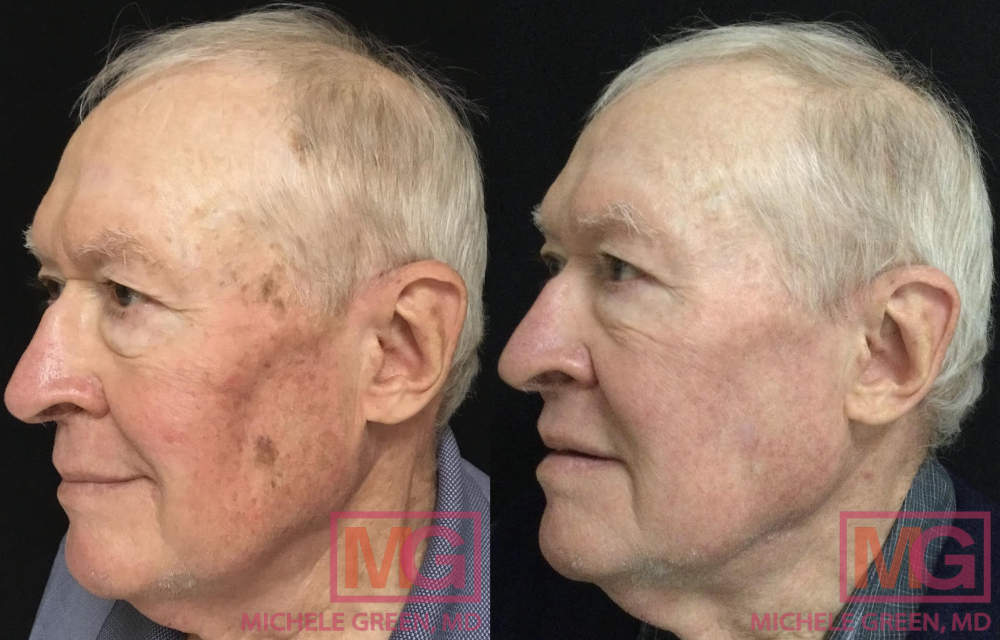
Alex-Trivantage Laser for Hyperpigmentation
The Candela Alex-Trivantage Laser is an Nd: YAG laser designed to treat specific sun spots. The laser emits light at wavelengths absorbed by the pigment in dark spots on the skin. These melanin-rich areas turn light energy into heat, removing pigmentation and encouraging the growth of new, lighter, healthier skin cells. The laser precisely targets skin pigmentation, leaving surrounding tissue unharmed.
What is Intense Pulsed Light (IPL) laser therapy for sunspots?
Intense Pulsed Light (IPL) treatment, also called a “Photofacial,” is an excellent option for addressing various types of hyperpigmentation, including sun spots and redness, as well as fine lines and visible blood vessels, and for improving skin texture. The treatment works by emitting multiple wavelengths of light that penetrate the skin’s dermal layer and are absorbed by melanin-rich cells that create sun spots. These cells convert light energy into heat, helping to break down the pigment. IPL differs from other laser treatments, such as the Candela Alex-Trivantage, because it uses multiple wavelengths of light rather than a single wavelength to target skin issues. The procedure is safe and effective, usually causing minimal discomfort. Most patients describe the sensation as feeling like a light snap of a rubber band on the face. Afterward, there’s no downtime or recovery needed so that patients can resume their normal activities immediately.
How long does it take for sunspots to fade after an IPL?
Intense Pulsed Light (IPL) treatment is a highly effective option for reducing the appearance of sunspots across all skin types. Patients may see a visible decrease in sunspots after their first session. However, most will need multiple treatments, spaced 4-6 weeks apart, to achieve the best results. With each IPL session, patients will notice their skin looks better.
Is IPL or Pico Laser better for sunspots?
IPL and the Pico laser both help reduce sunspots on the skin’s surface. The Picosure picosecond laser is an FDA-approved treatment that effectively removes tattoos, resurfaces skin, diminishes acne scars, minimizes fine lines and wrinkles, and enhances skin texture. It uses ultra-short laser pulses lasting a trillionth of a second to produce pressure waves that break down pigmentation, allowing the body to eliminate it naturally. Neither treatment is automatically “better.” Instead, Dr. Green will recommend the most suitable option for you.
Is IPL or Fraxel better for brown spots?
Both Intense Pulsed Light and Fraxel skin resurfacing treatments can help improve sun damage. Both are offered at Dr. Green’s New York City dermatologist’s office, and neither is inherently “better.” Instead, it’s about choosing the treatment that best matches your specific aesthetic goals and needs. The first step is to schedule an appointment with board-certified dermatologist Dr. Michele Green. During your initial consultation, you will discuss your goals and medical history, and Dr. Green will examine the treatment area to create your customized plan. IPL treatment is a gentler option, ideal for patients with light skin and dark hyperpigmentation spots, while Fraxel provides more noticeable results.
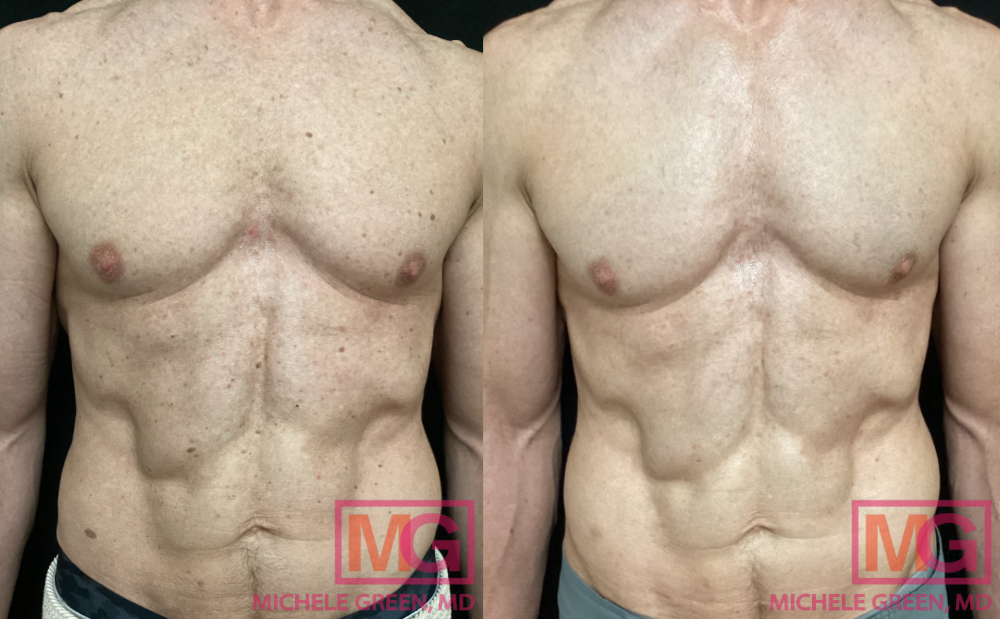
What is the strongest laser for hyperpigmentation?
The most effective laser for hyperpigmentation is an ablative laser, which removes the outer layer of skin to increase skin cell renewal and stimulate the body’s natural healing process. Ablative laser treatments deliver significant results but involve a longer recovery period and carry a risk of more serious side effects, such as pain, redness, infection, and keloid scars. They are not recommended for patients with Fitzpatrick skin types III-VI, as the risk of keloid scarring is higher for those with darker skin tones.
How many laser treatments are needed to remove sunspots?
The number of treatment sessions needed to remove sunspots varies based on several factors, including the extent of sun damage and the type of laser used. Most patients will need multiple sessions for the best results, though they should start to notice improvement after just one. After your initial consultation and treatment, Dr. Green will develop a treatment plan. Usually, patients return 4-6 weeks after each session for a follow-up.
Does laser sunspot removal work? How to get started with laser sunspot treatment today
While days in the sun are enjoyable for most people, you must wear sunscreen and practice strict sun protection whenever you’re outside. Signs of sun damage, which can include fine lines, wrinkles, sagging skin, broken capillaries on the nose, dark spots, precancerous lesions, and worsening melasma, often appear in patients in their 40s but result from sun exposure during their youth. Although the best way to prevent photoaging is to avoid sun exposure in the first place, patients who show these signs can consider several treatment options, including laser therapy, chemical peels, topical solutions, dermal fillers, and microneedling. To find out which treatment is best for you, schedule an initial consultation with expert dermatologist Dr. Michele Green in NYC.
Dr. Michele Green is an internationally acclaimed, board-certified dermatologist with over 25 years of experience offering the best non-invasive treatment options. She adopts a holistic, less-is-more approach, designing personalized skincare routines and treatment plans tailored to her patients’ specific concerns and aesthetic goals. Recognized consistently by Castle Connolly, New York Magazine, and Super Doctors, she is regarded as one of New York’s top dermatologists for her dedication and expertise. Call us at 212-535-3088 or email our New York City-based office today to schedule a consultation with Dr. Michele Green and discover the best treatment options for sun-damaged skin.


