


Cellulite Treatment
Cellulite is a common cosmetic concern that affects skin appearance, often causing dimpling or an uneven texture that can be difficult to improve with lifestyle changes alone. Many people seek cellulite treatment on the thighs, buttocks, abdomen, and arms to smooth the skin and improve confidence. Cellulite can develop at any age and may appear regardless of body weight or fitness level, which can be frustrating for those who maintain a healthy lifestyle. Over time, changes in skin firmness can make cellulite more noticeable, prompting many patients to explore professional treatment options. Current cellulite treatments offer non-surgical solutions that can significantly improve the appearance of dimpled skin with little to no downtime, making cellulite treatment one of the most frequently requested body procedures at Dr. Michele Green’s private dermatology office in New York City.
Cellulite treatments work by targeting the underlying factors beneath the skin that cause visible dimpling and uneven texture. Depending on the treatment, cellulite reduction may involve stimulating collagen production to improve skin firmness or releasing the fibrous tissue that pulls the skin downward, creating indentations. These approaches are designed to smooth the skin’s surface and improve texture without surgery or prolonged recovery. In some cases, treatments may be combined or performed in stages to achieve smoother, more even-looking skin in the targeted area. This individualized approach is why consulting an experienced, board-certified dermatologist like Dr. Michele Green is essential to effective cellulite reduction.
Dr. Michele Green is an internationally recognized, board-certified dermatologist with over 25 years of experience in advanced non-surgical cosmetic treatments, including cellulite reduction. Known for her holistic, less-is-more philosophy, Dr. Green personalizes each treatment plan to the patient’s skin, body concerns, and goals. She is consistently recognized by Castle Connolly, New York Magazine, and Super Doctors as one of New York City’s top dermatologists for her expertise and dedication to patient care. When you consult with Dr. Green at her private Upper East Side dermatology practice, she will work closely with you to develop a customized treatment plan to smooth cellulite and enhance your skin’s appearance.
What is cellulite?
Cellulite is a common skin condition caused by the tension between an accumulation of fat cells beneath the skin’s surface and fibrous septa, leading to rippling or lumpy, dimpled skin. The connective tissue, or septae, that connects the skin to the underlying muscle consists of fibrous bands that affect skin structure, resulting in dimpling. As fat cells increase and expand, they bulge toward the skin’s surface. The fibrous bands pull back against the fat cells, creating the appearance of dimples and ripples along the skin. Cellulite is not considered a medical condition. It occurs in people of all body types and fitness levels and is a normal variation in skin structure. While it cannot be completely prevented, in-office treatment options can significantly improve the appearance of cellulite by addressing skin firmness, collagen production, and the structures beneath the skin that contribute to dimpling.
What are the different grades of cellulite?
In the Journal of the European Academy of Dermatology and Venerology, published in 2009, doctors developed a severity scale to assess cellulite. The scale defined three grades, ranging from grade 1 to 3.
- Grade 1 – (mild) superficial dimpling with an “orange peel” appearance and 1-4 slight skin depressions.
- Grade 2 – (moderate) deeper skin rippling with a “cottage cheese”-like appearance and 5-9 medium skin depressions.
- Grade 3 – (severe) deep skin rippling with a “mattress-like” appearance and ten or more deep depressions.
Why cellulite happens
Cellulite results from structural changes beneath the skin that affect the smoothness and texture of the skin’s surface. Its pathophysiology involves changes in fat cells, connective tissue, and skin firmness. Although the exact cause of cellulite is not fully understood, dermatologists have identified common patterns in how cellulite forms within the skin. Beneath the dermis, fat cells are held in place by fibrous connective tissue bands that attach the skin to the underlying muscle. These bands help maintain the skin’s shape and support, but they do not stretch like fat tissue. As fat cells enlarge or shift over time, they press upward toward the skin’s surface while the connective tissue bands continue to pull downward. This opposing pull creates visible dimpling and surface irregularities that characterize cellulite. Skin thickness, collagen levels, and elasticity play important roles in how noticeable these changes appear. When collagen levels decrease, and the skin loses firmness, the underlying structural changes become more visible, which is why cellulite often becomes more apparent with age, even without significant weight changes.
When does cellulite appear?
Cellulite often develops earlier in life than many people expect. In some individuals, changes beneath the skin that contribute to cellulite can start during adolescence or early adulthood. Hormonal changes during puberty influence fat storage patterns and connective tissue development, which can affect when cellulite begins to form. Genetics is also a major factor, which is why cellulite can appear in young people regardless of weight or activity level. In many cases, these changes develop slowly and may not be noticeable at first, becoming apparent later in life.
What is the best cellulite treatment?
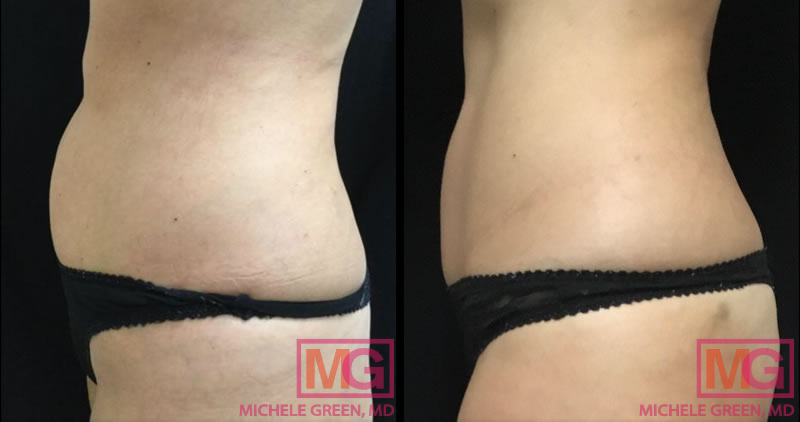
Several fat-reduction and skin-tightening treatments approved by the U.S. Food and Drug Administration (FDA) for cellulite reduction have no side effects. With many options available at Dr. Green’s office, it is important to note that no one treatment is inherently “better” than another; rather, the most important step is to determine the treatment or series of treatments that will work best for you. The best way to find the right treatment option is to consult with Dr. Green in her New York City dermatology office. The most popular treatments offered at Dr. Green’s office are designed to improve the appearance of cellulite and include Thermage radiofrequency laser treatment and Sculptra dermal filler injections.
Thermage for cellulite reduction treatment
Thermage is a non-invasive skin-tightening and cellulite-reduction procedure that uses radiofrequency energy to stimulate collagen production in the skin’s dermal layers. Collagen is a key structural protein that supports skin firmness and smoothness. By replenishing collagen, Thermage helps increase skin elasticity and smooth out cellulite dimples. With its newly designed total-body tip, Thermage® FLX can penetrate deeper into the skin painlessly and effectively to tighten and smooth the skin. The procedure takes approximately 1 hour, and results are gradually visible over 4 to 6 months. Thermage® is suitable for all skin types and offers no downtime, allowing patients to easily schedule treatment sessions and resume normal daily activities immediately after the procedure. Thermage can be performed on nearly any body area, including the buttocks, upper thighs, abdomen, and upper arms.
Sculptra Injections for cellulite treatment
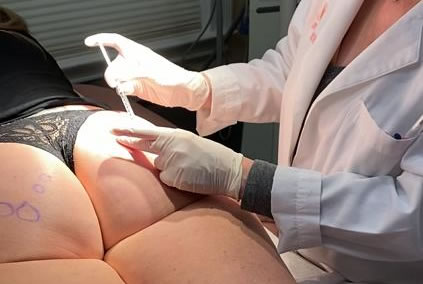
Sculptra is a dermal filler made of poly-L-lactic acid, an FDA-approved substance that stimulates collagen production and corrects skin depressions and surface irregularities. Many patients use Sculptra to address facial volume loss and reduce the appearance of textural acne scars; however, it can also be used for a non-surgical Brazilian Butt Lift (BBL) to diminish the look of cellulite on the buttocks. By promoting new collagen production in the buttocks, Sculptra injections can enhance the roundness, firmness, size, and volume of the buttocks while minimizing the appearance of cellulite dimples and rippling. A short series of injections, spaced 4 to 6 weeks apart, is required for optimal cosmetic results, after which patients can anticipate smoother, less-dimpled skin for up to two years.
Intense Pulsed Laser (IPL) therapy
Intense Pulsed Light (IPL) uses multiple wavelengths of light to address various skin conditions. With its broad wavelength range, IPL can treat numerous skin concerns, including skin laxity, hyperpigmentation, sun spots, age spots, acne scars, hair removal, rosacea, and broken blood vessels. The Forever Young BBL, a new IPL treatment from Sciton, delivers light energy to the skin’s dermal layer to stimulate collagen production, tighten the skin, and diminish the appearance of cellulite. Clinical studies suggest that the Forever Young BBL may alter the expression of genes linked to aging and longevity (doi: 10.1038/jid.2012.287). Patients typically undergo an initial series of 4 to 6 sessions spaced 1 month apart, followed by regular maintenance sessions to sustain and enhance their results.
Velashape for cellulite reduction
Velashape is a non-surgical body contouring procedure that combines cellulite reduction and body contouring for overall rejuvenation. It is a non-invasive treatment that uses heat, infrared light, radiofrequency, and vacuum technology to target the fibrous bands beneath the skin, improving the appearance of cellulite. The vacuum suction breaks up lumpy pockets beneath the skin, while infrared light and bipolar radiofrequency energy gently heat the fat cells and surrounding tissue. Ideal cellulite-reduction results are achieved with 5-6 treatment sessions spaced 3 weeks apart. After Velashape treatment, the skin texture in the treatment area is visibly smoother and firmer. Initial cellulite reduction results can be seen after three sessions. Velashape® is completely painless and requires no downtime after treatment. Each session takes less than an hour and can be done in any season and for all skin types.
Subcision with Cellfina for cellulite reduction
Cellfina is an FDA-approved subcision technique that targets and improves the dimples associated with cellulite. The Cellfina procedure uses a device with a blade the size of a small needle to physically break up the connective bands beneath the skin that cause the lumpy appearance of cellulite dimples. The number of Cellfina treatments required to smooth the skin depends on the number of dimples in the treatment area. The dimples targeted during a session are typically permanently removed; however, new cellulite dimples can still form, as there is currently no way to prevent them. There are a few days of downtime after a Cellfina procedure, and patients can expect swelling, bruising, and tenderness in the treatment area for several days afterward. There may be some discomfort during the procedure, though local anesthesia is typically used to help reduce it. The results are long-lasting and can be observed as early as a few days after the procedure.
Cellulaze cellulite treatment
Cellulaze is an invasive cosmetic treatment designed to temporarily improve the appearance of cellulite on the buttocks and thighs. During the procedure, a small incision is made to insert a laser fiber into the subcutaneous tissue. The heat from the laser fiber breaks apart the fibrous bands that intensify the appearance of cellulite dimples. The treatment also melts some of the excess fat cells that bulge and contribute to cellulite. Additionally, Cellulaze’s laser energy stimulates collagen production within the skin, boosting elasticity and increasing thickness. The number of treatments needed to achieve optimal cosmetic results varies with the severity of cellulite and the number of areas treated. Results may be visible after a single treatment, though several sessions are typically required to achieve the best results. Cellulaze is associated with several weeks of downtime, and patients can expect bruising, swelling, and soreness in the treatment areas following the procedure. Generally, results from Cellulaze can last up to 12 months.
Endermologie cellulite treatment
Endermologie is a cellulite-reduction treatment that uses a handheld device to deliver a targeted deep-tissue massage to an area of the body, breaking apart the dimples of cellulite. The massage effectively tones and tightens the skin, but several sessions are needed to see results. After completion of the procedure, patients may experience slight bruising and muscle soreness in the treated area. The effects of Endermologie treatments can last for up to a year.
Acoustic wave therapy
Acoustic wave therapy is an in-office treatment option. The provider uses a handheld device that emits sound waves to stimulate the connective tissues in the treatment area. The vibration improves circulation and stimulates collagen buildup, which is said to improve the appearance of cellulite. Typically, several treatment sessions are needed to see results, and those results can last for up to two years, depending on the area treated.
Emtone radiofrequency treatment
Emtone is an anti-cellulite treatment that uses radiofrequency (RF) technology to address the various causes of cellulite. The Emtone delivers RF energy and heat to the treatment area at temperatures between 108 and 110 degrees Fahrenheit. As a result, new elastin and collagen are produced, tightening and smoothing the skin. Acoustic waves are also emitted from the Emtone device to increase circulation in the treatment area and boost skin cell turnover. The Emtone treatment can be used on all areas of the body that may be affected by cellulite, including the arms, legs, buttocks, and abdomen.
Aveli for the treatment of cellulite
Aveli is a minimally invasive procedure FDA-cleared for cellulite reduction on the buttocks and thighs. Aveli works by targeting the fibrous bands, or septae, that pull down on fat cells and create the appearance of cellulite dimples. The provider (a board-certified dermatologist or plastic surgeon) marks the dimples to be treated, and the device is inserted beneath the skin’s surface to alter the structure of the septae, releasing tension and resulting in smoother skin texture. Similar to Cellfina, Aveli relies on mechanical subcision technology, though it offers more precise treatment. Common side effects of Aveli include bruising and swelling in the treatment area. Usually, a single treatment session is effective for reducing cellulite, though it cannot prevent new dimples from forming.
Microdermabrasion to reduce the appearance of cellulite
Microdermabrasion is best suited for patients with grade 1 cellulite. This treatment is performed by a dermatologist who uses aluminum oxide crystals to exfoliate the skin. The exfoliation of the treated area stimulates skin cell turnover, promotes the generation of healthy new skin cells, and improves the skin’s overall appearance. Several treatments are needed to see results. However, this treatment method is generally less effective at improving the appearance of cellulite than newer, more innovative laser treatments such as Thermage. During your consultation with Dr. Green, you can discuss which treatment options best suit your skin condition and desired cosmetic results.
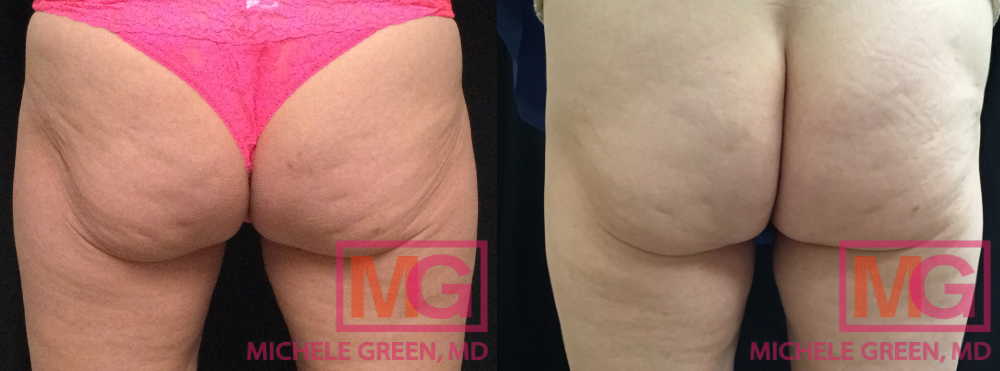
Before and After Thermage
What is the most effective cellulite treatment?
The most effective cellulite treatment depends on what is contributing to cellulite in a particular area of the body. In some cases, cellulite is more noticeable due to reduced skin firmness and collagen loss, which makes dimpling more prominent on the skin’s surface. When this is the primary factor, treatments that stimulate collagen production and improve skin tightness can help smooth the skin and reduce the visibility of dimples. In other cases, cellulite is caused by tight connective tissue beneath the skin that pulls the surface inward, creating more defined depressions. For this reason, treatments that target areas beneath the skin may yield greater improvement than skin-tightening procedures. Careful evaluation helps ensure the treatment plan targets the actual cause of the dimpling.
Will cellulite go away with weight loss?
Weight loss typically does not make cellulite disappear because fat reduction does not alter the connective tissue patterns that contribute to dimpling. While losing weight can reduce the size of fat cells, it does not alter the connective tissue structure beneath the skin that contributes to dimpling. In some cases, weight loss can make cellulite more noticeable, particularly when accompanied by reduced skin firmness. This occurs when the skin does not tighten at the same rate as fat loss, allowing existing dimples to stand out more clearly. Weight loss reduces the size of fat cells but does not change the tight connective tissue that pulls the skin downward, which is why cellulite often remains visible. For this reason, weight loss alone, including approaches such as liposuction, is not considered a reliable solution for reducing the appearance of cellulite. Cosmetic surgery focuses on fat removal or contouring and does not correct the skin texture changes that cause cellulite. Plastic surgery procedures are not designed to improve the fibrous structures beneath the skin that contribute to cellulite.
How to treat cellulite naturally
Natural approaches can help maintain skin health and may reduce the appearance of mild cellulite over time, especially with consistent use. Regular movement promotes healthy circulation, which can influence how the skin looks and feels in areas prone to dimpling. Strength-based exercises can also improve muscle tone beneath the skin, which may contribute to a firmer overall appearance. Nutrition plays a role as well, since diets that support collagen production and skin hydration, along with certain supplements, can help maintain skin quality as the body changes over time. Practices such as dry brushing or gentle massage are often used to temporarily smooth the skin and improve its appearance day to day. Dry brushing, a form of Ayurvedic medicine, involves using a bristled brush on dry skin to exfoliate and promote lymphatic drainage. This technique stimulates blood and lymph flow, removes dead skin cells, and encourages new skin cell growth, which may improve the appearance of cellulite. Managing weight fluctuations and maintaining skin elasticity can also help limit changes that make cellulite more noticeable. While natural methods do not remove cellulite, they can be a helpful part of a routine focused on maintaining smoother-looking skin and complementing professional treatments.
Frequently Asked Questions about Cellulite Treatment
Is QWO cellulite treatment still available?
QWO is no longer available for patients seeking treatment for cellulite. QWO injectable treatment was the first injectable treatment for permanently getting rid of cellulite dimples on the buttocks. Cellulite treatment with QWO injections targets fibrous bands that connect the skin to the underlying muscle and pull down on bulging fat cells, creating the appearance of cellulite. Breaking up these fibrous bands released tension on the protruding fat cells, allowing the skin to smooth out. Additionally, QWO stimulated collagen production in the skin, tightening and firming it. Unfortunately, QWO injections for cellulite reduction were no longer available to patients as of January 2023, due to concerns about excessive and prolonged bruising in the treatment area. There is no longer any access to QWO injections, as the manufacturer has discontinued production. Although QWO is no longer available as a cellulite reduction treatment, there are still many other treatment options for cellulite available at Dr. Michele Green’s private dermatology office in the Upper East Side neighborhood of Manhattan, such as Thermage FLX and Sculptra injections.
What is cellulite treatment?
Cellulite treatment is the broad term for any treatment that reduces the appearance of dimpling and rippling on the skin’s surface. Treatments such as Thermage FLX use radiofrequency to stimulate collagen production, creating smoother, firmer skin and minimizing the appearance of cellulite. Sculptra injections use poly-L-lactic acid to stimulate collagen and correct skin dimpling. Subcision treatments, such as Cellfina, physically break down the fibrous bands that cause skin dimpling. Most cellulite treatments are non-invasive, with minimal downtime and side effects. Dr. Green offers a variety of cellulite treatment options that reduce its appearance, delivering long-lasting, natural-looking results.
Is cellulite treatable?
Yes, cellulite can be treated, and many patients see excellent improvement in skin appearance with the right approach. Although cellulite is a common, natural condition, advances in non-invasive treatments now make it possible to smooth dimples and improve overall skin texture. These treatments focus on reducing the visibility of cellulite and enhancing skin firmness. When carefully selected and tailored to the individual, cellulite treatments can deliver noticeable, natural-looking results. A personalized consultation helps match the treatment to a patient’s skin, concerns, and goals, setting realistic expectations and achieving improvements that boost confidence.
Where does cellulite come from?
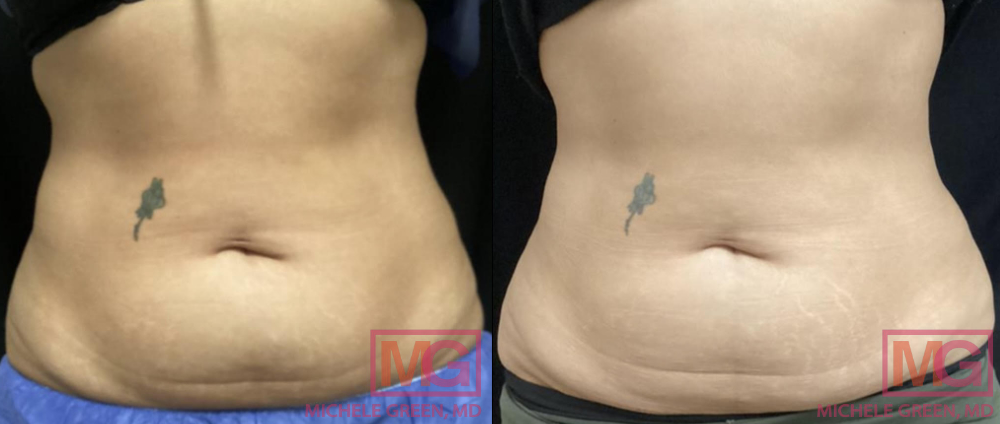
Cellulite develops in specific areas of the body where fat storage patterns and connective tissue structure make dimpling more likely. Although there is no single known cause of cellulite, it most commonly appears on the thighs, buttocks, hips, abdomen, and upper arms, areas where fat is naturally stored in higher concentrations. Genetics strongly influence how fat is distributed throughout the body, how connective tissue is arranged, and how thick or elastic the skin is, which helps explain why cellulite often runs in families. Hormones also play an important role, particularly estrogen, which affects fat storage, circulation, and connective tissue structure, and contributes to the higher prevalence of cellulite in women. Over time, natural changes in skin firmness, collagen production, and circulation can make cellulite more noticeable in areas that are already predisposed, even in individuals who maintain a healthy weight and active lifestyle.
Is cellulite natural?
Yes, cellulite is a natural, harmless skin condition that is common. Cellulite is a common skin condition that can affect anyone, regardless of gender, age, or weight. However, it is more prevalent in women than in men; in fact, it affects over 90% of women compared to less than 10% of men. Women’s fat is typically stored in areas of the body, such as the buttocks and thighs, which commonly develop cellulite. Additionally, women tend to have naturally thinner skin than men, which can make cellulite more visible. Cellulite is also more common with aging, as skin laxity increases and the condition becomes more pronounced. Its appearance may worsen with weight gain, yet cellulite can also affect individuals with a slender build. Cellulite results from a combination of factors; fat itself is not the sole cause. While cellulite is not dangerous or harmful, its appearance may be perceived as unsightly. For many, cellulite may induce feelings of self-consciousness or low self-esteem.
What treatments work for cellulite?
Several treatments can improve the appearance of cellulite by making the skin look smoother and more even. These treatments work by addressing the changes beneath the skin that cause dimpling. Some treatments help the skin become firmer, making dimples less noticeable, while others focus on loosening the underlying tissues that pull the skin inward. Over time, these improvements can help the skin in the treated area look more uniform and refined. The degree of improvement varies from person to person and depends on factors such as how visible the cellulite is, where it appears on the body, and how the skin looks and feels in that area. While no treatment can completely remove cellulite, in-office procedures performed by an experienced dermatologist can noticeably improve skin texture and help patients feel more confident about the appearance of treated areas.
Which cellulite treatment is most effective?
The most effective cellulite treatment depends on choosing an option that aligns with a patient’s skin characteristics and aesthetic goals. Cellulite does not look the same on everyone, and its appearance varies by skin quality, firmness, and the area being treated. Some treatments are designed to smooth uneven texture and improve the overall look of the skin, while others are better suited to addressing more noticeable dimpling. The best results come from choosing a treatment based on the patient’s skin and goals, not from using the same approach for every case. A professional consultation allows these factors to be evaluated carefully, so patients can achieve visible, natural-looking improvement.
How long does cellulite treatment last?
The cellulite-reduction treatments offered at the private dermatology office deliver long-lasting results. Although no cellulite treatment can achieve permanent reduction or prevent new dimples from forming, patients can expect the cosmetic effects of their in-office treatments to last at least six months, with many lasting even longer. For example, Thermage FLX treatment can last up to two years after a single session. Most patients interested in cellulite reduction will engage in regular maintenance sessions as part of their plan to maintain optimal cosmetic results. During your consultation with board-certified dermatologist Dr. Michele Green, she will collaborate with you to create a personalized treatment plan that addresses your specific concerns and needs, along with a timeline that works best for you.
How much is cellulite treatment?
The cost of cellulite treatment varies based on several factors, including the treatment area, the procedure selected, and the number of sessions recommended to achieve the desired results. Because cellulite varies in appearance and severity from person to person, treatment plans are customized. During a consultation, the areas of concern are evaluated, and a plan is developed based on your goals and skin characteristics. This allows for a more accurate discussion of pricing and ensures that treatment is aligned with what will deliver the most noticeable improvement. When you meet with Dr. Green at her private dermatology office in New York City, she will review your options and create a plan that balances effectiveness, longevity of results, and overall value.
Do cellulite treatments work?
Yes, cellulite treatments can work, and many patients see visible improvement in their skin’s appearance with the right approach. Modern treatments target the underlying features that contribute to dimpling, including skin firmness and the structures beneath the surface that affect texture. Improvement often occurs as the skin responds to treatment, becoming smoother in the treated area. The degree of improvement varies based on factors such as the treatment type, the area treated, and individual skin characteristics. When performed by an experienced dermatologist, cellulite treatments can noticeably soften the appearance of dimples and create a more even skin surface.
Will cellulite go away with exercise?
Exercise can improve the appearance of cellulite, but does not directly eliminate it. Regular physical activity strengthens underlying muscles and improves circulation, which may make the skin look firmer and smoother over time. When muscles are more toned, the skin above them often appears tighter, softening the look of surface dimpling in some areas. Exercise also helps maintain overall skin health and body composition, contributing to a more even appearance. However, cellulite is influenced by factors beyond muscle tone, including connective tissue structure and skin quality, so exercise alone is usually insufficient to fully address it. Many patients find that while exercise improves overall body shape and firmness, targeted treatments are often needed to significantly reduce the appearance of cellulite.
Is cellulite fat?
No, while fat cells contribute to the appearance of cellulite, they are not the direct cause. As fat cells in the lower layer enlarge, they push against the connective tissue, creating the dimpled skin characteristic of cellulite. Lack of exercise, aging, poor diet, genetics, and hormonal factors can all contribute to the development of cellulite. Although exercise and diet can be managed to help prevent fat cells from accumulating and thereby reduce the development of cellulite, there is no guarantee. Since genetics plays a role in cellulite formation, some individuals are more predisposed to developing it than others. While fat cells contribute to cellulite’s appearance, people of any weight, size, or age can experience it.
Will cellulite improve with weight loss?
For some individuals, cellulite may improve with weight loss, but results vary widely and depend on skin quality and the body’s response to changes in fat volume. In people with good skin elasticity, a moderate reduction in fat can lead to a smoother appearance in certain areas. When the skin remains firm, changes in body composition may subtly soften the appearance of dimpling. In other cases, weight loss does not lead to noticeable improvement or may even enhance the appearance of existing cellulite. Improvement is more likely when weight loss is combined with in-office treatments that support skin firmness.
Do cellulite creams work?
Cellulite creams improve the appearance of cellulite by either reducing the water content of fat cells or thickening the skin’s outer layer. Some of the most effective over-the-counter skincare products for reducing cellulite are lotions and creams containing ingredients such as caffeine, retinol, alpha hydroxy acids, and aminophylline. The success of these topical lotions depends largely on the severity of your cellulite. Unfortunately, for grades 2 and 3, cellulite may not be best treated with topical treatments. Topical solutions may help improve the appearance of grade 1 cellulite and can enhance certain in-office cellulite treatments. While cellulite creams can temporarily reduce cellulite’s appearance, in-office body contouring treatments have proven to be more effective for reducing cellulite. A board-certified dermatologist like Dr. Michele Green in NYC is an expert in non-invasive cosmetic treatments that stimulate collagen production and improve the appearance of dimpled skin.
What cream is good for cellulite?
A good cellulite cream contains ingredients known to improve the skin’s appearance and feel. Many cellulite creams include caffeine, a common ingredient in body products designed to smooth the skin’s surface. Retinol is another ingredient often recommended because it can improve skin quality and thickness with consistent use. Some formulas also contain alpha hydroxy acids, which gently exfoliate the skin and help refine texture. Peptides, antioxidants, and hydrating agents are often included to support overall skin health and maintain a smoother appearance. When choosing a cellulite cream, look for a well-formulated product from a reputable brand and use it consistently as part of a regular body care routine.
When does cellulite start?
Cellulite usually becomes noticeable when changes in the skin make dimpling more visible. As the skin naturally loses firmness with age, previously invisible texture changes can become visible on the surface. Hormonal shifts can also play a role, since they affect how fat is stored and how the skin behaves over time. Weight changes may also influence when cellulite is noticed, especially if the skin does not tighten at the same pace. Some people may have cellulite for years before noticing it, while others notice it during periods of change, such as after weight loss or as the skin becomes looser with age. The timing can also vary by body area, with cellulite often becoming noticeable earlier on the thighs and buttocks than in other areas.
Will cellulite ever go away?
Cellulite is a common, natural skin condition that does not fully resolve on its own for most people. Its appearance can change over time and may become more or less noticeable depending on factors such as skin firmness, aging, hormonal changes, and weight fluctuations. While lifestyle habits like exercise and diet support overall skin health, they do not specifically eliminate cellulite. Cosmetic treatments can significantly smooth dimpling and improve skin texture, helping reduce the visibility of cellulite for extended periods. With ongoing care and appropriate treatment, many people can maintain smoother-looking skin and keep cellulite from becoming a persistent concern.
Where can I get cellulite treatment?
Cellulite treatment is typically offered at dermatology practices that specialize in non-surgical body treatments. These treatments are performed in medical offices where providers have access to advanced technologies designed to smooth dimpling and improve skin texture. A qualified provider will first evaluate the areas of concern, review your medical history, and discuss the improvement you hope to achieve. This consultation is an important step because it helps select the right treatment for your skin, body area, and goals. Receiving cellulite treatment in a professional medical setting also ensures that procedures are performed safely and appropriately, with proper guidance before and after treatment. Choosing an experienced, board-certified dermatologist gives you access to personalized care and a range of treatment options that can be adjusted over time to maintain results.
How do I get started with cellulite treatment today?
Cellulite treatment offers an effective, non-surgical way to improve the appearance of dimpled skin and uneven texture that often does not respond to diet or exercise alone. In-office cellulite treatments target the factors that contribute to visible dimpling, including reduced skin firmness and the connective tissue beneath the skin’s surface. These in-office procedures can help smooth the skin, improve texture, and create a more refined appearance in areas such as the thighs, buttocks, abdomen, and arms. Because cellulite presents differently from person to person, treatment is often customized and may involve one or more approaches to achieve the best outcome. An experienced board-certified dermatologist, such as Dr. Green in NYC, will work with you to develop a personalized cellulite treatment plan designed to help you feel more confident in your skin.
Dr. Michele Green is an internationally recognized, board-certified dermatologist with over 25 years of experience in advanced non-surgical cosmetic treatments, including cellulite reduction. She customizes each treatment plan to the patient’s skin type, body concerns, and aesthetic goals, leveraging her expertise to select the most appropriate approach. Dr. Green is consistently recognized by Castle Connolly, Super Doctors, and New York Magazine as one of New York City’s top dermatologists for her dedication to patient care and clinical expertise. When you schedule a consultation with Dr. Green at her private dermatology practice on Manhattan’s Upper East Side, she will work closely with you to create a personalized treatment plan focused on improving the appearance of cellulite and achieving smoother-looking skin. To learn more about cellulite treatment, please call Dr. Michele Green’s NYC office at (212) 535-3088 or contact us online to schedule a consultation today.


