


Non-Surgical Facelift vs. Facelift: Which Is Right for You?
As we age, the face gradually loses the tight, lifted contours of youth. Collagen production slows, the skin loses elasticity, and gravity takes its toll — leading to sagging skin, deeper nasolabial folds, jowls along the jawline, marionette lines around the mouth, and fine lines and wrinkles throughout the face. For patients seeking to address these changes, two broad paths exist: facelift surgery — a cosmetic procedure that physically repositions facial tissue — and the non-surgical facelift, which uses a combination of injectables and energy-based treatments to refresh and rejuvenate the face without a single incision. Understanding the differences, benefits, and limitations of each approach is key to making the right choice for your specific goals. Dr. Michele Green, a board-certified dermatologist in NYC, has helped countless patients understand these differences, benefits, and limitations and determine which approach is best for them.
The term ‘non-surgical facelift’ encompasses a range of minimally invasive treatments, from Botox and dermal fillers to Sculptra, laser skin resurfacing, and radiofrequency skin tightening — that work together to restore volume, smooth deep creases, and lift sagging facial contours without incisions or significant recovery time. A traditional facelift, by contrast, is a surgical procedure in which a board-certified plastic surgeon makes incisions along the hairline and around the ears to physically reposition facial tissue, tighten underlying muscles, and remove excess skin — delivering more dramatic correction for patients with significant laxity or major structural changes. Many patients prefer the non-surgical facelift route for its minimal downtime, lower risk profile, and the ability to achieve a refreshed appearance without going under the knife — though for patients with more advanced facial aging or a skin condition that requires physical tissue repositioning, facelift surgery may ultimately be the more appropriate and effective choice. For either path, consulting an experienced, board-certified dermatologist like Dr. Michele Green is an ideal starting point to determine which approach best fits your needs.
What is a facelift?
A traditional facelift (technically known as a rhytidectomy) is a cosmetic procedure performed by a board-certified plastic surgeon to reposition the underlying facial muscles and tissues and remove excess skin, creating a smoother, tighter, more youthful facial appearance. Facelift surgery typically involves incisions along the hairline, around the ears, and sometimes under the chin. Through these incisions, the surgeon lifts and repositions deeper facial structures, removes excess or sagging skin, and may incorporate liposuction to remove unwanted fat deposits or fat injections to restore volume where needed. Many patients also choose to combine facelift surgery with a neck lift to address neck laxity and banding. The procedure is typically performed under general anesthesia or IV sedation, and recovery time ranges from two to four weeks or longer, depending on the extent of the surgery. Newer techniques, such as robotic surgery and the mini facelift, have expanded the range of options available to surgical patients.
What is a non-surgical facelift?
A non-surgical facelift is not a single treatment but a customized combination of minimally invasive cosmetic procedures designed to restore a more youthful, refreshed appearance to the face. A liquid facelift uses injectables to rejuvenate the skin, while a non-surgical facelift also includes modalities such as laser energy. The most common components include Botox to relax dynamic wrinkles such as frown lines, crow’s feet, and forehead lines; hyaluronic acid dermal fillers to restore lost volume, smooth nasolabial folds, soften marionette lines, and redefine facial contours; and biostimulators such as Sculptra (poly-l-lactic acid) that stimulate collagen production over time to restore lost facial volume. Thermage, a radiofrequency treatment, is also frequently used to tighten lax skin and stimulate new collagen production, with no downtime. Fraxel laser skin resurfacing is another powerful addition to the non-surgical facelift toolkit, targeting fine lines, uneven texture, and sun damage to reveal smoother, more youthful-looking skin. Kybella injections may also be used to eliminate unwanted fat beneath the skin, creating a more defined jawline. Together, these treatments can produce a significant improvement in facial appearance — all without surgery, incisions, or general anesthesia.
What is the difference between a mini facelift and non-surgical options?
A mini facelift is a less extensive alternative to a traditional facelift, using smaller incisions and primarily focusing on lifting the lower face and jawline. It is often marketed as a “weekend facelift” because recovery time is shorter than with a full facelift. However, it still involves incisions, anesthesia, and a recovery period of one to two weeks. The mini facelift is generally best suited for patients with moderate jowling and lower facial laxity who are not yet ready for a full facelift. By contrast, a non-surgical facelift involves no incisions — treatments such as Botox, dermal fillers, Sculptra, Kybella, and laser procedures are delivered through injections or surface-level devices, with minimal to no downtime. For patients seeking a middle ground, Dr. Michele Green can develop a comprehensive non-surgical protocol that may deliver results comparable to those of a mini facelift.
Can a non-surgical facelift give the same results as surgery?
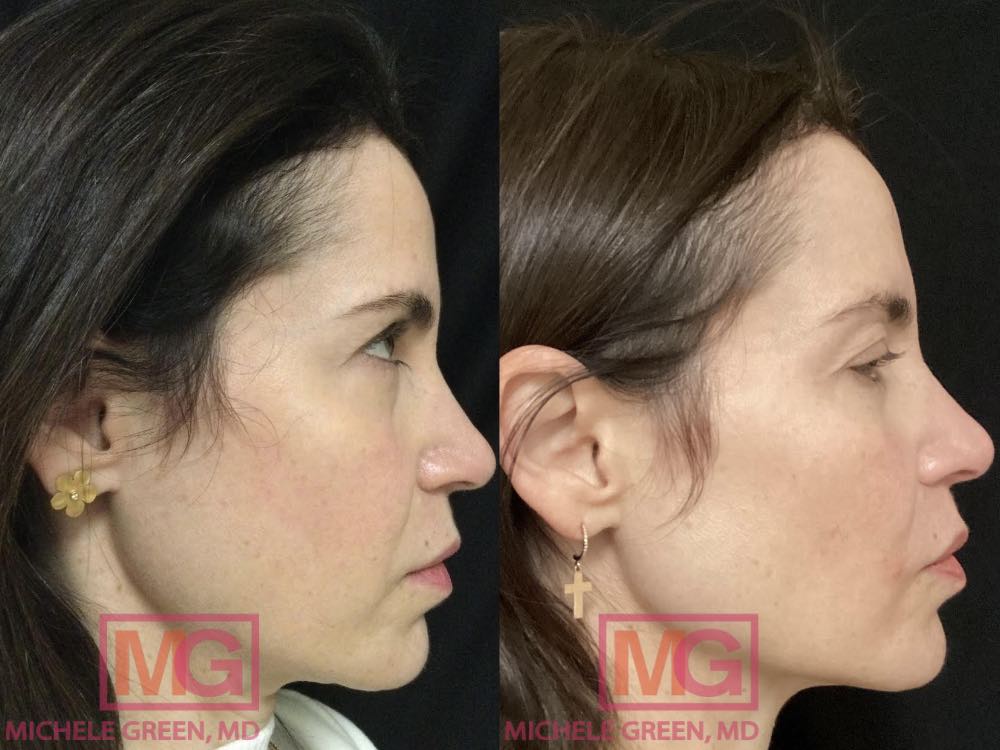
For the right patient, a well-designed non-surgical facelift can achieve results comparable to surgery — but it is important to have realistic expectations. Non-surgical treatments excel at restoring volume loss, softening fine lines and deep creases, improving skin texture and tone, and lifting mild to moderate sagging. They cannot remove excess skin or fully reposition significantly descended facial tissue — tasks that require the hands of a board-certified plastic surgeon performing facelift surgery. That said, for patients who address aging proactively by starting non-surgical treatments in their 30s and 40s and maintaining them consistently, the cumulative effect of Botox, dermal fillers, Sculptra, and energy-based treatments can be remarkably effective at preserving a youthful appearance — sometimes indefinitely delaying the need for facelift surgery altogether.
Who is a good candidate for a non-surgical facelift vs surgery?
A good candidate for a non-surgical facelift is someone with mild to moderate signs of facial aging — such as early jowling, volume loss in the cheeks or under the eyes, fine lines, nasolabial folds, and marionette lines — but without significant loose or sagging skin that would require removal. Ideal candidates also include those who prefer to avoid the risks and recovery time associated with cosmetic surgery, or those with medical conditions that make general surgery inadvisable. By contrast, facelift surgery is generally the better option for patients with significant skin laxity, deep creases, pronounced jowls, or loose neck skin that cannot be adequately addressed with injectables and energy-based treatments alone. A thorough consultation with Dr. Green can help patients understand which approach — or combination of approaches — will best meet their goals.
At what age should you consider a facelift over non-surgical options?
There is no single “right age” for facelift surgery. Many patients begin exploring non-surgical options in their late 30s and 40s, when the first signs of facial aging become more noticeable, and continue with injectable and energy-based treatments well into their 50s and beyond. Facelift surgery tends to become a more prominent consideration in a patient’s mid-to-late 50s or 60s, when skin laxity and tissue descent have progressed beyond what non-surgical treatments can adequately address. That said, some patients in their 40s with more pronounced facial aging may be good candidates for facelift surgery, while some patients in their 60s may be well-served by a robust non-surgical regimen. The best approach is to be evaluated individually, taking into account not just age but also skin quality, degree of laxity, volume loss, and overall health.
Can you combine non-surgical treatments to avoid a facelift?
Absolutely — and this is exactly the approach that Dr. Michele Green takes with many of her patients. By strategically combining non-invasive cosmetic procedures such as Botox, hyaluronic acid dermal fillers, Sculptra, Thermage, Fraxel laser skin resurfacing, and Kybella injections, it is possible to achieve a comprehensive facial rejuvenation that rivals surgical results for appropriate candidates. This combination approach has become one of the most popular treatment strategies at Dr. Green’s practice. The key is working with an experienced provider who understands facial anatomy and can customize a plan that addresses each patient’s specific concerns in a natural, harmonious way.
Cosmetic Procedures for a Non-Surgical Facelift
Dermal fillers to restore lost volume
Dermal fillers are among the most versatile and effective tools in the non-surgical facelift arsenal. Juvederm, Restylane, and Belotero are hyaluronic acid-based fillers that can be precisely injected to restore lost volume, smooth nasolabial folds and marionette lines, refresh the under-eye area, and redefine the cheeks and jawline. Hyaluronic acid fillers provide immediate results and can last 6 to 12 months, depending on the specific filler used. Sculptra, a poly-L-lactic acid biostimulator, works differently — rather than adding immediate volume, it gradually stimulates the skin’s collagen production over several months. After an initial series of treatments, Sculptra results can last up to 2.5 years, delivering a subtle, natural-looking improvement in overall facial fullness and skin quality. Used together or individually, these fillers can be tailored to each patient’s unique anatomy and aesthetic goals, making them a cornerstone of the non-surgical facelift approach.
Botox injections to treat dynamic wrinkles
Botox is one of the most popular and well-established treatments in the non-surgical facelift toolkit. As a neuromodulator, Botox temporarily relaxes the facial muscles responsible for dynamic wrinkles — the lines that form from repeated facial expressions over time. Common treatment areas include frown lines between the brows, forehead lines, and crow’s feet around the eyes. Botox can also be injected into the platysmal bands in the neck to soften vertical neck bands and into the masseter muscles to slim the jawline. Results typically appear within one to two weeks after treatment and last three to four months, making Botox an easy, low-downtime option for patients seeking to maintain a refreshed, youthful appearance as part of their overall non-surgical facelift plan.

Thermage for non-surgical skin-tightening
Thermage is a non-invasive radiofrequency treatment that has become a key component of the non-surgical facelift for patients seeking to address skin laxity without surgery. By delivering controlled radiofrequency energy deep into the skin, Thermage heats the underlying tissue to stimulate collagen production and tighten existing collagen fibers — resulting in firmer, smoother skin over time. It is particularly effective for sagging skin along the jawline, around the eyes, and in the neck. One of Thermage’s biggest advantages is that it requires just a single treatment session with no downtime, making it an appealing option for busy patients. Results continue to improve over three to six months as new collagen develops and can last two years or more.
Fraxel Dual laser skin resurfacing
Fraxel Dual is a fractional laser skin-resurfacing treatment that uses two wavelengths to target distinct skin concerns. The 1550nm wavelength penetrates deep into the skin to stimulate collagen production and remodel the underlying tissue, making it particularly effective for softening fine lines, deep creases, and acne scars. The 1927nm wavelength targets the skin’s surface, addressing sun damage, uneven pigmentation, and overall skin tone and texture. The 1550nm wavelength is most commonly used in a non-surgical facelift plan because it delivers comprehensive improvement in skin quality and radiance that injectables alone cannot achieve. With the 1550nm setting, patients often experience mild redness or swelling for 48 hours after treatment. Many patients require a short series of treatments spaced 4-6 weeks apart to achieve the aesthetic results they desire.
Kybella injections to remove unwanted fat
Kybella is an FDA-approved injectable treatment that destroys fat cells beneath the chin and along the jawline, making it a valuable addition to the non-surgical facelift for patients seeking to address a double chin or improve definition along the lower face and neck. Kybella’s active ingredient is deoxycholic acid, a naturally occurring molecule that breaks down and permanently destroys fat cells on contact — once targeted fat cells are eliminated, they cannot return. Treatments are typically performed in a series of 2 to 4 sessions spaced about a month apart, with most patients noticing noticeable improvement in chin and jawline definition after their first or second session. While some temporary swelling and bruising are expected after each treatment, Kybella offers a compelling non-surgical alternative to liposuction for patients seeking to refine their facial contours.

What are the limitations of a non-surgical facelift vs surgery?
The primary limitation of a non-surgical facelift is that it cannot remove excess skin or surgically reposition deeply descended facial tissues. Patients with significant skin sagging, pronounced jowls, deep neck banding, or loose neck skin that has lost substantial elasticity will not achieve the same degree of correction with non-surgical treatments as they would with facelift surgery. Additionally, non-surgical treatments require ongoing maintenance — Botox typically lasts three to four months, hyaluronic acid fillers six to twelve months, depending on the product and area, and even Sculptra’s collagen-stimulating effects will gradually diminish over two to three years. For patients who are unwilling or unable to commit to periodic maintenance treatments, facelift surgery may offer a more practical long-term solution.
While facelift surgery can deliver dramatic, long-lasting results for patients with significant facial aging, it is not without limitations. The procedure requires general anesthesia or IV sedation, carries the inherent risks of any surgery — including infection, scarring, nerve damage, and prolonged swelling — and involves a recovery period of two to four weeks, during which normal activities are restricted. Results, while long-lasting, are not permanent, as the natural aging process continues after surgery. Additionally, if a patient is unhappy with their surgical outcome — whether due to visible scarring, an overly tight appearance, or asymmetry — correcting those results can be extensive, costly, and technically challenging, and may require additional surgery. For all these reasons, many patients find that the lower-risk profile, minimal downtime, and flexibility of a non-surgical facelift make it the more appealing first choice for facial rejuvenation.
Is a non-surgical facelift worth it compared to surgery?
For the right patient, a non-surgical facelift is absolutely worth it. Patients who are good candidates — those with mild to moderate facial aging, realistic expectations, and a willingness to maintain their results over time — frequently report high satisfaction with their non-surgical facelift outcomes. The ability to address fine lines, volume loss, nasolabial folds, crow’s feet, and early jowling without surgery, incisions, or meaningful downtime is a significant advantage. For patients with more significant aging concerns, facelift surgery may ultimately be the more cost-effective and satisfying long-term choice. The most important step any patient can take is to schedule a consultation with an expert provider, such as Dr. Michele Green, who can honestly assess whether non-surgical treatments, facelift surgery, or a combination of both will best serve their individual goals.
What do surgeons say about non-surgical facelifts versus surgery?
Most board-certified plastic surgeons and dermatologists agree that non-surgical and surgical facelift options are complementary rather than competitive. Many plastic surgeons recommend that patients begin with non-surgical treatments earlier in life to slow aging and preserve results, reserving facelift surgery for when facial aging truly warrants it. Similarly, experienced dermatologists like Dr. Michele Green often work in tandem with surgical colleagues, referring patients for facelift surgery when their goals exceed what non-surgical treatments can achieve, while providing pre- and post-surgical care and non-surgical maintenance. The consensus in the field is that both approaches have their place, and the best outcomes are achieved when patients receive thoughtful, individualized guidance from qualified, experienced providers.
Non-surgical facelift vs facelift: which one has a faster recovery time?
A non-surgical facelift is the clear answer for faster recovery. A traditional facelift typically requires two to four weeks of recovery, during which patients may experience bruising, swelling, tightness, and discomfort. Activities are restricted, and most patients take one to two weeks off from work. By contrast, recovery from a non-surgical facelift is minimal — most patients return to normal activities immediately or within a day or two of treatment, with only minor bruising or swelling that resolves quickly.
Non-surgical facelift versus a facelift: which lasts longer?
In terms of longevity, facelift surgery has a clear advantage over individual non-surgical treatments. A well-performed facelift by an expert, board-certified plastic surgeon can deliver results that last 7 to 10 years or more. However, the natural aging process continues, and most patients opt for touch-ups over time. By contrast, the individual components of a non-surgical facelift have varied durations: Botox lasts three to four months, most hyaluronic acid dermal fillers last six to twelve months, Sculptra’s collagen-stimulating effects can last two to three years, Thermage lasts up to two years, and Kybella is permanent so long as excess weight is not gained. However, when non-surgical treatments are maintained consistently, their cumulative benefit can compound over time — many patients who commit to a regular non-surgical regimen find that their results are remarkably sustained, even if no single treatment lasts as long as a facelift on its own.
Non-surgical facelift vs facelift: which is safer?
From a risk standpoint, non-surgical treatments generally have a more favorable safety profile than facelift surgery. Surgical procedures inherently carry risks associated with anesthesia, infection, scarring, prolonged recovery, nerve damage, and other complications that can occur during or after any cosmetic surgery. The most significant risks of non-surgical treatments — such as bruising, swelling, and, in rare cases, vascular occlusion with dermal fillers — are far less serious and typically resolve quickly when performed by an experienced, skilled provider like Dr. Michele Green. That said, non-surgical treatments are not entirely without risk, and it is essential to seek care from a board-certified dermatologist, such as Dr. Green in NYC, with in-depth knowledge of facial anatomy and injection techniques.
Non-surgical facelift vs facelift: which gives more natural results?
Both approaches, when performed skillfully, can yield natural-looking results — but each carries the risk of an “overdone” appearance. In the hands of an expert like Dr. Michele Green, a non-surgical facelift using Botox, dermal fillers, Sculptra, Thermage, Fraxel, and Kybella can restore a naturally refreshed, youthful appearance without altering the face’s fundamental character. Overfilling or improper placement of fillers, however, can create an unnatural, “pillow face” appearance. Similarly, facelift surgery performed by a skilled, board-certified plastic surgeon should result in a refreshed, natural look — but aggressive removal of excess skin or overly tight repositioning can result in a pulled, windswept appearance. The key in both cases is working with highly experienced providers who prioritize natural-looking facial rejuvenation over dramatic transformation.
Non-surgical facelift vs facelift: how do the costs compare?
When comparing costs, facelift surgery typically carries a higher upfront price tag, including the surgeon’s fee, anesthesia, facility costs, and postoperative care. Non-surgical treatments are generally less expensive per session. Still, because they require ongoing maintenance, the cumulative cost over several years can approach, or in some cases exceed, the cost of surgery. That said, many patients find the trade-off worthwhile, given that non-surgical options involve little to no downtime and can be adjusted as needed. It is also worth noting that neither facelift surgery nor non-surgical facelift treatments are typically covered by insurance, as both are considered elective cosmetic procedures.

How do I get started with a non-surgical facelift or a surgical facelift today?
Both non-surgical and surgical facelifts are excellent options for facial rejuvenation — the right choice depends on the degree of facial aging, your aesthetic goals, and your tolerance for downtime. For patients with mild to moderate aging, a non-surgical facelift performed by an expert like Dr. Michele Green can produce impressive results with little to no downtime. Patients with more significant laxity, pronounced jowls, or deep creases may find that facelift surgery delivers the more dramatic correction they seek. Most patients prefer the non-surgical route due to its significantly reduced recovery time, lower risk profile, and the flexibility to adjust results over time. By combining non-surgical treatments, Dr. Green can stimulate collagen production, restore lost facial volume, and achieve facial rejuvenation, resulting in a beautiful, more youthful appearance.
Dr. Michele Green is a board-certified dermatologist in NYC with over 25 years of experience delivering the most advanced non-surgical facelift treatments. Dr. Green has consistently been named among New York’s best dermatologists by Castle Connolly, The New York Times, Super Doctors, and New York Magazine for her dedication to patients and her meticulous, individualized approach to care. Her private practice on Manhattan’s Upper East Side offers a full range of Botox, dermal fillers, Sculptra, Thermage, Fraxel, and Kybella treatments designed to restore a youthful, refreshed appearance without surgery. If you are ready to take the next step toward facial rejuvenation, please contact us online or call 212-535-3088 to schedule your consultation with Dr. Green today.


