


Sculptra for Cellulite
Cellulite is one of the most common cosmetic concerns, affecting most women at some point in their lives, regardless of body weight or fitness level. Those telltale cellulite dimples on the buttocks and thighs form when fibrous bands of connective tissue tether the skin down while fat deposits push upward, creating an uneven, puckered skin texture. Diet, exercise, and topical creams can help the skin look healthier. Still, they rarely make a lasting dent in cellulite dimpling because they do not address the structural changes happening beneath the surface. That is why so many patients have become curious about Sculptra for cellulite, an injectable approach that stimulates collagen deep within the skin.
Sculptra is an injectable made of poly-L-lactic acid, or PLLA, a biocompatible, biodegradable substance that stimulates collagen rather than acting as a traditional dermal filler. Instead of simply adding volume, Sculptra injections prompt the body to rebuild its own collagen over the following weeks and months, thickening and strengthening the skin. As a result, the dimpling underneath is less visible. Many patients also love that Sculptra restores volume and lift to the buttocks while it smooths, making it a true two-for-one body treatment. With minimal downtime, gradual natural-looking results, and benefits that can last two years or more, Sculptra for cellulite reduction is an excellent option for the right candidate when performed by an experienced injector like board-certified dermatologist Dr. Michele Green in NYC.
Does Sculptra Work for Cellulite?
Yes, Sculptra can noticeably improve the appearance of cellulite for many patients, especially those whose dimpling is made worse by thinning skin and skin laxity. Cellulite is not just about fat. Research has shown that cellulite is closely tied to the breakdown of collagen and elastic tissue in the deeper layers of the skin, which is why it tends to become more visible with age even when weight stays the same. Because Sculptra boosts collagen production, it targets a root contributor to cellulite rather than simply camouflaging it. A 12-month study published in the Journal of Drugs in Dermatology in July 2026 found that women with moderate to severe cellulite on the backs of the thighs saw progressive improvement after one to three Sculptra sessions, with high satisfaction and improvements in skin laxity by the one-year mark. While no injectable can promise complete cellulite removal, Sculptra can soften dimples, refine the skin’s texture, and create a firmer, smoother surface. During your consultation, board-certified dermatologist Dr. Green will assess whether your cellulite responds best to Sculptra.
How Does Sculptra Treat Cellulite?
Cellulite develops when fibrous bands, known as septae, that connect the skin to the underlying muscle pull downward while fat deposits press upward, much like the buttons on a quilted mattress. As collagen breaks down with age, the skin above becomes thinner and less supportive, so these ripples show through more clearly. Sculptra is made of tiny microparticles of poly-L-lactic acid (sometimes written as poly-L lactic acid), which are injected into the deep dermis and just below it, where they gently signal the skin’s fibroblasts to ramp up collagen production. Over the following months, the PLLA particles are naturally absorbed by the body, leaving behind a sturdier network of collagen and connective tissue. This increase in skin thickness acts like a firmer cushion over the connective tissues and fat below, so cellulite dimpling appears smoother and less pronounced. Because Sculptra is a collagen stimulator rather than a gel that sits in the skin, collagen stimulation builds gradually, and the results look completely natural. Board-certified dermatologist Dr. Green uses a hyperdilute technique for body treatments, spreading the product evenly across the treatment area to encourage uniform, even results.
Is Sculptra FDA-Approved for Cellulite?
In the United States, Sculptra is FDA-approved for correcting facial wrinkles, such as smile lines and fine lines in the cheek area, but it is not currently FDA-approved specifically for cellulite. Using Sculptra for cellulite is considered an off-label use, which is a common and legal practice in which experienced physicians use an FDA-approved product in a different area of the body based on clinical evidence and expertise. Interest in Sculptra for the body has grown quickly, though. In Europe, Galderma, the maker of Sculptra, received Medical Device Regulation certification expanding Sculptra’s use to several body areas, including improving the appearance of cellulite, and Galderma is currently running clinical trials in the United States evaluating Sculptra for skin irregularities of the buttocks. Because off-label body treatments require a thorough understanding of anatomy, dilution, and injection technique, choose a highly experienced injector like board-certified dermatologist Dr. Michele Green.
Where Can Sculptra Be Used for Cellulite?
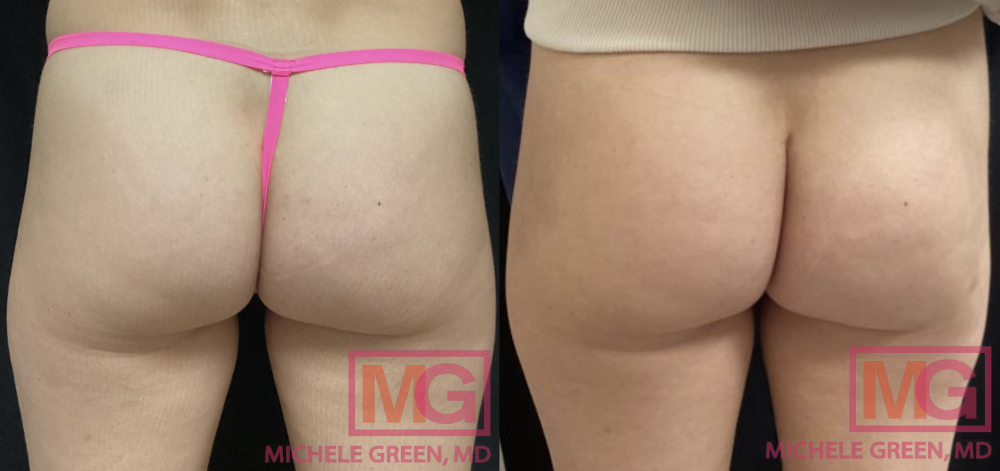
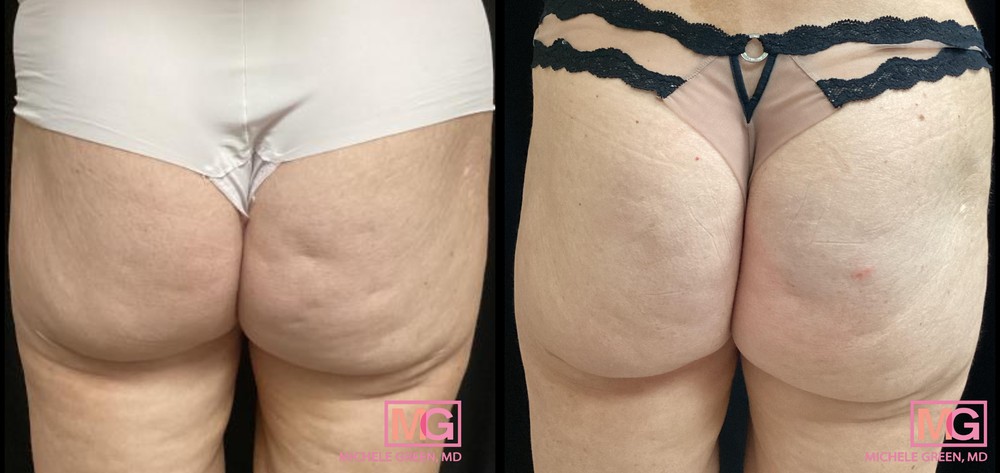
Sculptra can be used on most areas of the body where cellulite tends to appear. The most popular treatment areas are the buttocks and the backs and sides of the thighs, which is where cellulite is most common and where most of the clinical research has been focused. In the buttock area, Sculptra offers a unique advantage because it not only smooths cellulite dimples but can also restore volume, improving roundness and lift, which is why it is often used as part of a non-surgical butt lift. On the thighs, the back of the thigh has the strongest research, showing steady improvement over 12 months, while the outer and inner thighs respond well when crepey, loose skin is part of the concern. Sculptra can also be used to improve mild dimpling and laxity above the knees, on the hips, and on the abdomen and upper arms. Patients with especially deep, tethered dimples on the buttocks or thighs may see the best results when Sculptra is paired with a treatment that directly releases the fibrous bands. During your consultation, board-certified dermatologist Dr. Green will map the areas that will benefit most from treatment.
Who Is a Good Candidate for Sculptra for Cellulite?
The ideal candidate for Sculptra for cellulite is a healthy adult with mild to moderate cellulite, especially when it is accompanied by thinning skin, crepiness, or skin laxity. Patients who notice that their cellulite has become more visible with age, after pregnancy, or after weight loss often respond particularly well, since their concern is driven largely by collagen loss. Good candidates are also close to their goal weight, have realistic expectations, and are comfortable with a gradual treatment that unfolds over several months. Sculptra is not recommended for patients who are pregnant or breastfeeding, those with an active skin infection or inflammation in the treatment area, those with a history of keloids or hypertrophic scarring, or anyone with a known allergy to any of Sculptra’s ingredients. Patients with autoimmune conditions or bleeding disorders should also review their medical history carefully before treatment. When you meet with board-certified dermatologist Dr. Green in NYC, she will review your medical history, examine your skin, and determine whether Sculptra is the right fit for you.
Sculptra vs. QWO vs. Cellfina vs. Radiesse: Which Is Best for Cellulite?
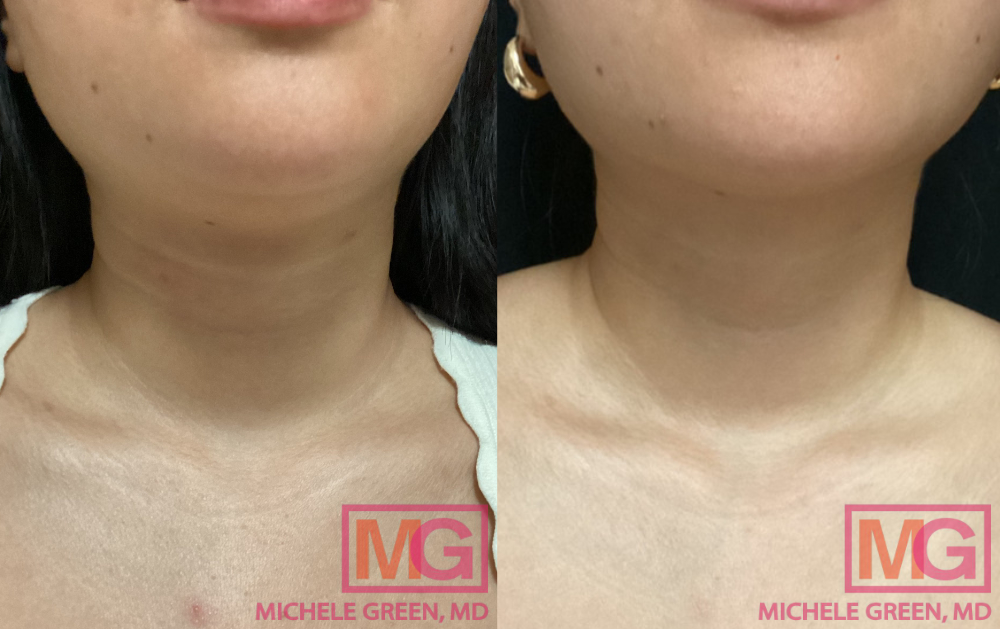
Patients researching cellulite treatments often come across these four names, but each one works very differently. QWO, a collagenase injection, made headlines as the first FDA-approved injectable for buttock cellulite in adult women, but its manufacturer stopped producing it at the end of 2022 due to concerns about extensive bruising and prolonged skin discoloration, so it is no longer available. Cellfina is an FDA-cleared, minimally invasive subcision procedure that uses a tiny blade to cut the fibrous band beneath each dimple, offering long-lasting results for deep, well-defined dimples, though it does not improve thin or lax skin, and bruising and tenderness can linger for several days. Radiesse, made of calcium hydroxylapatite, is another collagen-stimulating injectable that can be hyperdiluted for use on the body and tends to show results a bit sooner, while Sculptra builds collagen more gradually and its results often last longer.
For most patients whose cellulite is driven by thinning skin, laxity, and volume loss, Sculptra is the most versatile choice because it improves skin thickness, firmness, and texture across the entire treatment area while also restoring shape to the buttocks. Patients with a handful of very deep, tethered dimples may benefit from adding a structural release treatment like Cellfina alongside Sculptra, while Radiesse can be a good alternative for patients who want a slightly faster timeline. Board-certified dermatologist Dr. Green will evaluate your skin and help determine which approach, or combination of approaches, is best for you.
Does Sculptra for Cellulite Hurt?
Most patients find Sculptra for cellulite very tolerable, with only mild pressure or a quick pinch as each Sculptra injection is placed. Before treatment, Sculptra is mixed with sterile water and lidocaine, a local anesthetic, and a topical numbing cream can also be applied for added comfort. On the day of your appointment, the skin is cleansed, and the areas of cellulite dimpling are marked, often while you are standing so that each dimple is easy to see. The diluted product is then distributed evenly beneath the skin with a fine needle or a blunt-tipped cannula using a fanning pattern, which helps create smooth, uniform results. A typical session takes about 30 to 45 minutes, depending on the size of the area being treated. Immediately afterward, your injector will massage the treated area to evenly distribute the product before you head home with instructions for at-home massage. Thanks to board-certified dermatologist Dr. Green’s gentle, precise injection technique, most patients are pleasantly surprised by how comfortable the experience is.
What Is the 5-5-5 Rule After Sculptra?
The 5-5-5 rule is an easy way to remember the most important part of Sculptra aftercare: massage the treated area for five minutes, five times a day, for five days after each session. Massaging the treated area helps distribute the poly-L-lactic acid particles evenly beneath the skin, which supports smooth, uniform collagen production and lowers the risk of small bumps, known as nodules, forming under the skin. For body treatments, patients typically use the palms of their hands with a little lotion and firm, circular motions over the buttocks or thighs. Massaging the treated areas is easy to work into your daily routine, such as after a shower, in the morning while getting ready, or before bed. Board-certified dermatologist Dr. Green will demonstrate the proper massage technique before you leave the office so that you feel confident continuing at home.
What Is the Downtime After Sculptra for Cellulite?
One of the biggest perks of Sculptra for cellulite is the minimal downtime. Most patients return to work and their normal daily activities right away, aside from some temporary tenderness when sitting if the buttocks were treated. Mild swelling, redness, and bruising at the injection sites are common and typically fade within a few days to a week. Patients are generally advised to avoid strenuous exercise, saunas, and hot tubs for 24 to 48 hours, and to avoid alcohol and non-essential blood-thinning supplements, such as fish oil, for a few days before and after treatment to minimize bruising. Wearing loose, comfortable clothing on treatment day can also make the trip home more pleasant. Keep in mind that early swelling may make the area look smoother right away, but this fades within days, and the real collagen-building results develop over the following weeks. Board-certified dermatologist Dr. Green will provide detailed aftercare instructions tailored to your specific treatment area.
What Are the Risks of Sculptra for Cellulite?
Sculptra has a well-established safety record built over more than two decades of use, and most side effects are mild and temporary, including bruising, swelling, redness, tenderness, and itching at the injection sites. The most discussed risk is the formation of nodules, which are small, firm bumps beneath the skin that can develop if the product clumps together in one spot. Today’s hyperdilute body techniques, proper injection depth, and diligent massage after treatment have made nodules far less common than they were in Sculptra’s early years, and many soften on their own over time. More rarely, inflamed nodules called granulomas, infection, or uneven results can occur. Choosing an injector who understands proper dilution, placement, and technique is the single most important way to minimize these risks, which is why so many patients trust board-certified dermatologist Dr. Green in NYC for their Sculptra treatments.
How Many Sculptra Sessions Do You Need for Cellulite?
Most patients need two to three Sculptra sessions for cellulite, spaced about four to six weeks apart, to build enough collagen for a visible, lasting improvement. Because the body is a much larger canvas than the face, each session typically requires several vials of Sculptra per area. The exact number of sessions and vials depends on the size of the treatment area, the severity of your cellulite, your current skin thickness, and how your body responds to treatment. Patients with more advanced cellulite or significant skin laxity may benefit from an additional session. After the initial series, a single maintenance session every 18 months to two years can help sustain your results. Board-certified dermatologist Dr. Green will recommend a treatment schedule based on your individual needs and goals during your consultation.
How Long Does It Take to See Sculptra Results on Cellulite?
Sculptra is a treatment that rewards patience. Any immediate smoothing you notice after your appointment is mostly due to swelling and the fluid used to dilute the product, which fades within a few days. True results appear gradually as your body produces new collagen, with most patients noticing early improvements in firmness and skin texture about six to eight weeks after their first session. Results continue to build with each treatment, and the full effect is typically seen about three to six months after the final session. In clinical research on the thighs, improvements continued through the full 12-month follow-up. Many patients love that the change is gradual and natural-looking, so friends notice that their skin looks firmer and smoother without being able to pinpoint why. Board-certified dermatologist Dr. Green takes photos throughout your treatment series so that you can track your progress over time.
How Long Do Sculptra Cellulite Results Last?
Because Sculptra stimulates your body to build its own collagen, its results are among the longest-lasting of any injectable, typically lasting two years or more. Once the PLLA particles are absorbed, the new collagen remains in place and continues to support the skin long after treatment. That said, Sculptra does not stop the natural aging process, and factors such as genetics, hormonal changes, weight fluctuations, and the ongoing loss of collagen with age can eventually make cellulite more visible again. Maintaining a stable weight, staying active, and scheduling periodic touch-up sessions can help you enjoy smoother skin for as long as possible.
Can You Combine Sculptra With Other Cellulite Treatments?
Absolutely. Because cellulite has several causes, combining cellulite treatments often delivers the most dramatic improvement. A popular pairing at Dr. Green’s office is Sculptra with Thermage FLX. This radiofrequency skin-tightening treatment heats deeper skin layers to tighten existing collagen and stimulate collagen renewal, enhancing Sculptra’s firming effects. You can also combine Sculptra with subcision procedures like Cellfina to release deep fibrous bands, body-contouring treatments such as CoolSculpting to reduce stubborn fat deposits, or laser treatments that further refine tone and texture. Timing matters when combining treatments, so energy-based procedures are typically scheduled before Sculptra or several weeks after. Board-certified dermatologist Dr. Green will create a personalized combination plan that addresses every factor contributing to your cellulite. To explore all of your options, you can also learn more about cellulite treatment at Dr. Green’s practice.
Frequently Asked Questions (FAQs) about Sculptra for Cellulite
How Much Does Sculptra for Cellulite Cost?
The cost of Sculptra for cellulite varies from patient to patient because it depends on how many vials are needed, the size and number of treatment areas, the severity of your cellulite, and how many sessions are required to reach your goals. Body treatments typically require more product than facial treatments, and since Sculptra for cellulite is a cosmetic procedure, it is not covered by insurance. Because collagen-building results can last two years or more, many patients find that Sculptra offers excellent long-term value compared with treatments that need frequent repeating. The best way to get an accurate estimate is to schedule a consultation with board-certified dermatologist Dr. Green, who will evaluate your skin and design a customized treatment plan.
What Causes Cellulite?
Cellulite is caused by a combination of skin structure, fat, and connective tissue. Beneath the skin, fibrous bands tether the skin to the underlying muscle, and when fat cells expand, they push upward while these bands pull down, creating the familiar dimpled look. Women are far more likely than men to develop cellulite because their connective tissue bands tend to run vertically, forming more pronounced pockets for fat to bulge through, while men’s bands run in a crisscross pattern. Genetics, hormones such as estrogen, aging, reduced circulation, and declining collagen and elasticity all play a role, which is why even very fit people can have cellulite. Board-certified dermatologist Dr. Green can help identify which factors are driving your cellulite and how best to treat it.
Is Sculptra a Dermal Filler?
Sculptra is often grouped with dermal fillers, but it works quite differently from most. Traditional fillers fill a specific wrinkle or hollow immediately with a gel. At the same time, Sculptra is a biostimulatory injectable, also known as a collagen stimulator, that works over time by prompting your body to produce its own collagen. In other words, Sculptra helps your skin rebuild its foundation rather than simply filling it in. This makes it especially well suited for broad areas like the buttocks and thighs, where the goal is overall firmness and smoother skin texture rather than filling a single line. Collagen stimulators like Sculptra and Radiesse are a cornerstone of the natural-looking rejuvenation that board-certified dermatologist Dr. Green is known for.
How Is Sculptra Different From Hyaluronic Acid Fillers?
Hyaluronic acid fillers, such as Juvederm and Restylane, are made of a smooth gel that attracts water and adds instant volume wherever it is placed. They are excellent for the lips, cheeks, and under-eye hollows. Still, they are not ideal for treating cellulite, since filling individual dimples with hyaluronic acid would require a large amount of product and the results would be temporary and potentially uneven. Sculptra, on the other hand, improves skin quality by stimulating collagen, providing more uniform, longer-lasting smoothing across larger areas. Board-certified dermatologist Dr. Green will recommend the right product for each area you would like to treat.
Can Sculptra Lift the Buttocks While Treating Cellulite?
Yes! One of the most popular benefits of Sculptra on the buttocks is that it can improve shape and lift while it smooths cellulite. When placed strategically in specific areas, Sculptra gradually builds volume and projection, which is why it is often referred to as a non-surgical Brazilian butt lift. Patients can choose to focus on cellulite smoothing, volume enhancement, or both, and the number of vials and injection pattern are adjusted accordingly. Unlike surgical butt augmentation, there is no surgery, no fat transfer, and minimal downtime when you receive Sculptra from board-certified dermatologist Dr. Green.
Can Liposuction Get Rid of Cellulite?
No, liposuction is not an effective cellulite treatment. Liposuction removes fat from deeper layers to reshape the body, but it does not release the fibrous bands responsible for dimples or improve the skin’s texture. In some cases, removing fat can even make cellulite look worse by leaving the overlying skin looser and more irregular. The same is true of weight loss in general, which can shrink fat cells but does not change the connective tissue structure behind cellulite. Treatments that improve skin quality, like Sculptra, are a better fit for patients whose main concern is cellulite. Board-certified dermatologist Dr. Green can recommend the right body treatment for your goals.
Do Topical Creams Work for Cellulite?
Topical creams can offer modest, temporary improvement in the appearance of cellulite, but they cannot produce dramatic or lasting results. Ingredients like caffeine may temporarily tighten the skin to make dimples less noticeable, and retinol, used consistently over several months, may slightly thicken the skin. However, creams cannot reach the fibrous bands or deeper layers where cellulite forms. Keeping the skin moisturized and healthy is still beneficial and can complement in-office treatments. For noticeable results, in-office procedures like Sculptra performed by board-certified dermatologist Dr. Green are far more effective.
Can Men Get Sculptra for Cellulite?
Absolutely. While cellulite is far more common in women, men can develop it too, particularly with age, hormonal changes, or weight fluctuations. Men also frequently seek Sculptra to improve crepey, lax skin on the thighs, buttocks, and abdomen. The treatment process, results timeline, and aftercare are the same for men and women. Board-certified dermatologist Dr. Green welcomes male patients and will customize a plan to suit their anatomy and goals.
Is Sculptra for Cellulite Worth It?
For patients looking for a natural-looking, long-lasting way to reduce cellulite without surgery, Sculptra is well worth considering. It addresses a root cause of cellulite by rebuilding collagen, improves firmness and texture across the treatment area, can add volume and lift to the buttocks, and offers results that can last two years or more with minimal downtime. The key is having realistic expectations, since Sculptra can significantly soften cellulite but cannot erase every dimple or stop new cellulite from forming. When an experienced injector such as board-certified dermatologist Dr. Green in NYC performs it, Sculptra can be a rewarding investment in smoother, more confident skin.
Start Your Sculptra for Cellulite Treatment With Dr. Green Today
Sculptra for cellulite offers a smart, non-surgical way to smooth dimpled skin by addressing one of cellulite’s root causes: the gradual loss of collagen that leaves skin thinner and less able to hide the structures beneath it. Through a short series of injections, Sculptra stimulates your body’s own collagen production to improve skin thickness, firmness, and texture on the buttocks, thighs, and other areas, while also restoring volume and lift where it is needed. With minimal downtime, gradual natural-looking results, and benefits that can last two years or more, it is one of the most versatile options available for patients who want smoother skin without surgery. If you are ready to finally address your cellulite, Sculptra treatment with board-certified dermatologist Dr. Michele Green in NYC may be the perfect fit.
Dr. Michele Green is an internationally recognized, board-certified cosmetic dermatologist with over 25 years of experience providing some of the world’s most discerning individuals with the best non-invasive cosmetic treatments, including Sculptra injections, Radiesse, and Thermage FLX for body rejuvenation and cellulite reduction. Dr. Green takes a holistic, less-is-more approach to aesthetics, tailoring each treatment plan to the patient’s unique anatomy, skin quality, and goals. She is consistently recognized by Castle Connolly, New York Magazine, The New York Times, and Super Doctors as one of New York’s top dermatologists for her expertise and dedication to her patients. During your consultation at her private dermatology office on Manhattan’s Upper East Side, she will work closely with you to create a personalized Sculptra plan designed to help you achieve smoother, firmer skin. To learn more about Sculptra for cellulite and find out if it is right for you, please call Dr. Michele Green’s NYC office at 212-535-3088 or contact us online to schedule a consultation today.


