


Clascoterone for Hair Loss: What It Is and How It Compares
If you’ve spent any time researching hair loss treatments over the past year, you’ve likely come across a name that wasn’t on anyone’s radar five years ago: clascoterone. For decades, the conversation around androgenetic alopecia (AGA), more commonly known as male pattern hair loss, has centered on two options — oral finasteride and topical minoxidil. Clascoterone is different. It’s a topical anti-androgen that acts directly at the hair follicle rather than altering hormone levels throughout the body. Its phase 3 trials have generated more excitement in the hair loss world than anything in over thirty years. Patients in New York City constantly ask board-certified dermatologist Dr. Michele Green about it, wanting to know whether it’s real, available, and worth the wait.
The short answer is that clascoterone isn’t a fringe idea — it’s backed by real science and a large, well-designed set of clinical trials conducted by Cosmo Pharmaceuticals, the company developing it under the brand name Breezula. A related, lower-strength version of the drug is already FDA-approved for acne under the name Winlevi, so this isn’t an entirely new molecule; it’s a new use for one that’s already been through the regulatory process once. With strong trial data, the buzzy “539% improvement” headline, and the reasonable question of when—or whether—it will actually reach pharmacies, there’s a lot to unpack. Dr. Green breaks down what the research shows, how clascoterone compares with the treatments patients already use, and what to realistically expect in the years ahead.
Dr. Michele Green is a board-certified dermatologist with over 25 years of experience practicing on Manhattan’s Upper East Side. She stays closely engaged with emerging research in hair restoration and hair loss treatments, helping her patients distinguish genuine clinical progress from social media hype. She works with each patient to build a treatment plan tailored to their goals, health history, and hair loss pattern.
Androgenetic Alopecia
Androgenetic alopecia, commonly known as male pattern hair loss or male pattern baldness, is a genetic, hormone-driven form of hair loss that affects many men and women over their lifetimes. It’s caused by a hereditary sensitivity to DHT, which binds to the androgen receptor in the hair follicle and gradually shrinks it through miniaturization, shortening each hair growth cycle until the follicle produces finer, shorter hairs or stops producing visible hair altogether. In men, it typically appears as a receding hairline and thinning at the crown, while in women it tends to appear as diffuse thinning along the part line. On its own, established androgenetic alopecia isn’t reversible in the sense of undoing years of follicle miniaturization. Still, it is treatable: catching it early and starting a proven option like finasteride or minoxidil—or eventually an investigational option like clascoterone—can slow, stop, or in some cases partially reverse thinning. Dr. Green stresses that an accurate diagnosis is the first step, since not all hair loss is androgenetic alopecia, and the right treatment plan depends on identifying the actual cause.
How clascoterone works for hair loss
Clascoterone (chemical name: cortexolone 17α-propionate) is a topical androgen receptor inhibitor. Androgenetic alopecia, in both men and women, is driven largely by dihydrotestosterone (DHT), a byproduct of testosterone that binds to the androgen receptor in the hair follicle and gradually shrinks it through a process called miniaturization. Clascoterone works by occupying the androgen receptor at the follicle itself, blocking DHT from attaching there in the first place. Because it acts locally rather than traveling through the bloodstream, it’s designed to interrupt that follicular damage without meaningfully lowering DHT or testosterone levels elsewhere in the body.
Efficacy of clascoterone
While this concept sounds promising, does Clascoterone actually work for hair loss? Based on the data released so far, yes — and the results are considered among the most significant advances in hair loss treatment in decades. Two identically designed phase 3 trials, SCALP 1 (NCT05910450) and SCALP 2, enrolled a combined 1,465 men with male androgenetic alopecia and compared clascoterone 5% topical solution to a placebo vehicle. Both trials met their primary endpoint, showing statistically significant improvements in target-area hair count compared to placebo, along with positive patient-reported outcomes and a safety profile similar to the placebo group. Dr. Green notes that while the results are genuinely encouraging, they still need to undergo the FDA’s formal review process before clascoterone can be recommended as a proven, approved treatment.
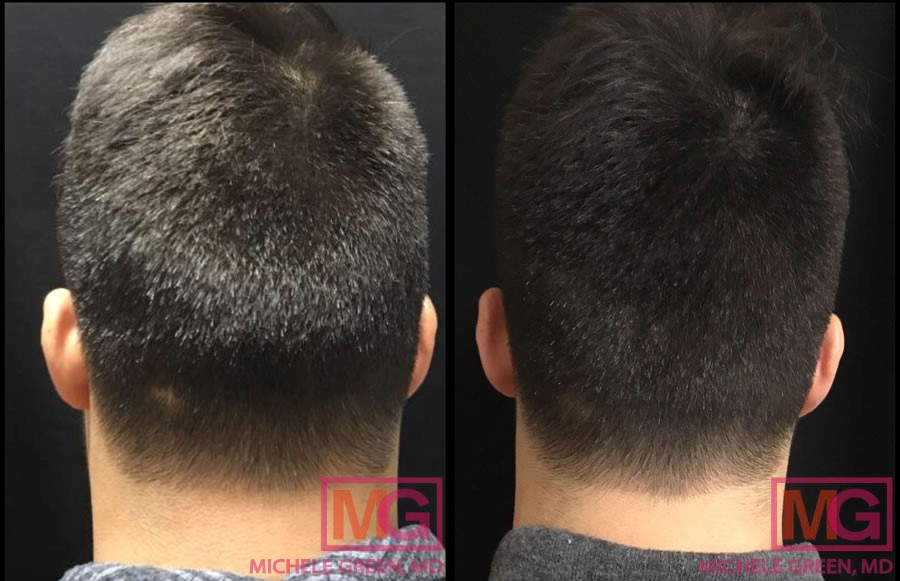
Head-to-head comparisons with other hair loss treatments:
Clascoterone vs. finasteride
The key difference is where each drug acts. Oral finasteride works systemically, lowering DHT throughout the body by blocking the enzyme that converts testosterone into DHT. It is effective but carries a small risk of sexual and hormonal side effects for some men. Clascoterone, by contrast, is a topical anti-androgen that blocks the androgen receptor locally at the hair follicle, with minimal systemic absorption. Some compounding pharmacies also offer topical finasteride as an alternative delivery method for the same oral drug, but that’s a different approach from clascoterone, which is a structurally distinct molecule rather than a reformulated version of finasteride. Based on raw hair-regrowth numbers, some early data suggest oral finasteride may still have a slight edge. Still, clascoterone appeals because it offers a comparable mechanism without the systemic exposure that concerns some patients.
Clascoterone vs. minoxidil
They’re not direct competitors because they work through different mechanisms. Minoxidil, whether topical or oral, is a vasodilator that increases blood flow to the follicle and extends the hair growth cycle, but it doesn’t address DHT. Clascoterone directly targets the hormonal driver of androgenetic alopecia by blocking the androgen receptor. Because they work on different pathways, Dr. Green notes that many hair loss treatments are combined rather than compared head-to-head, and clascoterone may eventually be used alongside minoxidil rather than in place of it.
Clascoterone vs. PRP for hair loss
These two sit at opposite ends of the hair loss treatment spectrum, since one is a daily topical drug and the other is an in-office procedure. PRP, or platelet-rich plasma, involves drawing a patient’s own blood, spinning it down to concentrate the growth factors, and injecting that concentrate directly into the scalp to stimulate blood flow and prolong the hair follicle’s growth phase. It doesn’t target DHT or the androgen receptor, so its mechanism differs fundamentally from clascoterone’s targeted, hormone-blocking approach. PRP also has a much less standardized evidence base than clascoterone: protocols vary widely among providers in terms of platelet concentration and injection technique. While multiple studies show it improves hair density and thickness, it hasn’t undergone the kind of large-scale, placebo-controlled phase 3 trials that clascoterone has. Dr. Green sees the two as more complementary than competing — PRP addresses the scalp environment and blood supply, while clascoterone (once approved) would address the androgen-driven cause of miniaturization itself — and some patients may ultimately benefit from combining hair loss treatments from both categories rather than choosing one over the other.
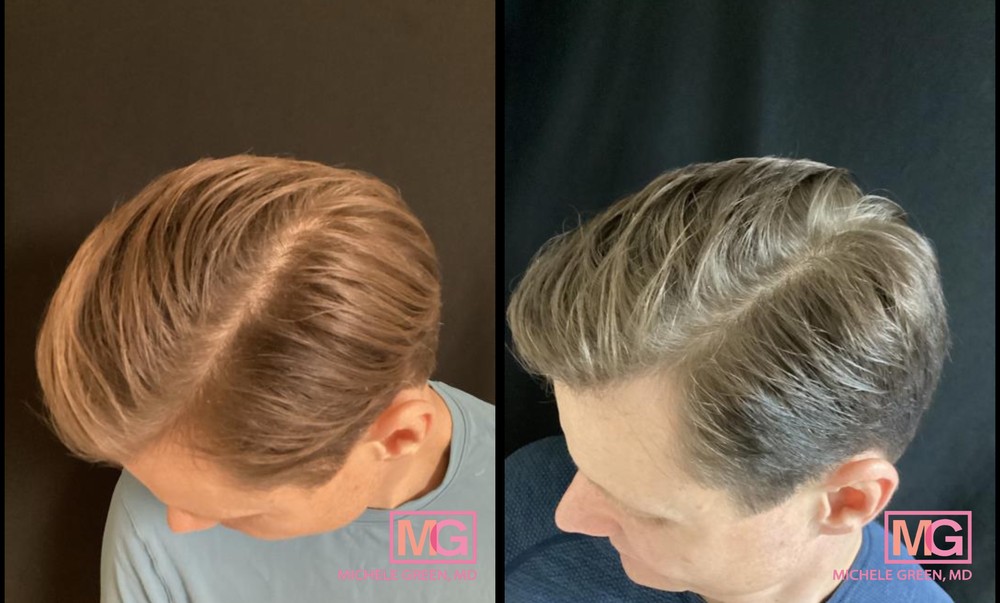
Does clascoterone regrow hair or just prevent loss?
Based on the phase 3 data Cosmo Pharmaceuticals has released, both prevention and regrowth are part of the picture. Patients using the clascoterone 5% topical solution didn’t just experience slower thinning — they saw measurable increases in target-area hair count and growth compared with their baseline, indicating actual hair regrowth in areas that were miniaturizing, not merely a pause in further loss. That said, like most hair loss treatments, clascoterone appears to work best on follicles that are still active but shrinking, rather than on areas that have been completely bald for years. Dr. Green explains that this is true of nearly every AGA treatment, current or investigational: earlier intervention tends to produce better results.
The side effects of clascoterone
So far, the side effect profile reported in the phase 3 trials has been reassuring. Treatment-emergent side effects with clascoterone 5% topical solution were similar in frequency to those with the placebo vehicle, and most reactions were mild and skin-related — such as redness, dryness, itching, or irritation at the application site. Because clascoterone is designed to remain localized to the scalp with minimal systemic absorption, it hasn’t shown the same pattern of hormone-related side effects associated with oral finasteride. Dr. Green notes that formal safety monitoring is ongoing, including a 12-month follow-up period, so the full long-term safety picture isn’t finalized yet.
How long does clascoterone take to work?
Based on the phase 3 trial timeline, meaningful improvements in target-area hair count took several months to appear, with data collected and compared at multiple points over 12 months. This aligns with how most hair loss treatments work — hair grows in cycles, so it typically takes at least three to six months of consistent use before visible changes appear, and the fullest results usually take longer. Dr. Green reminds patients that this pattern isn’t unique to clascoterone; it applies to finasteride, minoxidil, and virtually every other approach to hair regrowth.
Do you have to use clascoterone forever?
Based on the phase 3 data, yes — clascoterone appears to require ongoing use to maintain results, as with finasteride and minoxidil. In the 12-month trial, patients who continued clascoterone kept gaining hair, while those who switched to placebo after month seven saw their gains begin to reverse. This aligns with the general behavior of androgenetic alopecia: it’s a chronic, progressive condition, so stopping any effective hair loss treatment typically allows the underlying miniaturization process to resume.
FDA approval status
No, not yet. Clascoterone 1% cream is FDA-approved for acne under the brand name Winlevi. The 5% topical solution studied for male pattern hair loss has completed its phase 3 trials and is now finishing a required 12-month safety follow-up. Afterward, Cosmo Pharmaceuticals plans to file a new drug application (NDA) with the FDA. Until the FDA submits, reviews, and approves that application, clascoterone is not an FDA-approved hair loss treatment. Dr. Green cautions patients against sourcing it from unregulated sources in the meantime.

Frequently Asked Questions (FAQs) about Clascoterone
Where can I buy clascoterone for hair loss?
You can’t, at least not in its studied, effective form. Breezula, the 5% clascoterone topical solution for hair loss, is investigational and hasn’t been approved or sold anywhere in the world yet. Winlevi, the 1% clascoterone cream, is available by prescription for acne, and some patients have used it off-label on the scalp. However, it’s at a concentration fivefold lower than what was studied for hair loss, so there are no efficacy data to support that use. Dr. Green recommends caution with anyone selling “clascoterone for hair loss” online, since no legitimate, approved product exists yet.
How much will clascoterone cost?
Pricing hasn’t been announced because clascoterone for hair loss hasn’t been approved or brought to market. Once Breezula receives FDA approval, its cost will likely be shaped by factors such as insurance coverage, whether a generic becomes available, and how it’s positioned relative to existing hair loss treatments. In the meantime, Dr. Green advises focusing on treatments that are already available and proven rather than budgeting for a product with an unconfirmed price and release date.
When will Breezula (clascoterone) be available?
There’s no confirmed release date yet, but the timeline is becoming clearer. Cosmo Pharmaceuticals — sometimes shortened to CosmoPharma in industry coverage — is completing a required 12-month safety follow-up for its phase 3 trial participants, expected to wrap up in the spring. Afterward, the company plans to file its NDA with the FDA in early 2027. Given that FDA review of a new drug application typically takes 10 to 12 months, a realistic earliest approval would be in mid-to-late 2027, though drug timelines can and do shift.
Does clascoterone cause sexual side effects like finasteride?
Early data suggest it’s far less likely, and that’s one of clascoterone’s biggest selling points. Oral finasteride’s sexual side effects are linked to its systemic reduction of DHT throughout the body, which can affect libido and sexual function in a small percentage of men. Because clascoterone acts locally at the hair follicle rather than lowering circulating DHT or testosterone, phase 3 trials haven’t shown the same signal for sexual side effects. Dr. Green cautions that it hasn’t been studied as long or in as many patients as finasteride, so it’s a promising early finding, not a guarantee.
Does clascoterone lower DHT?
Not in a meaningful, systemic way — and that’s the whole point of its design. Unlike oral finasteride or dutasteride, which lower DHT throughout the body by blocking the enzyme that converts testosterone into DHT, clascoterone doesn’t reduce how much DHT the body produces. Instead, it blocks DHT from binding to the androgen receptor specifically within the hair follicle, so the follicle is shielded from DHT’s effects even though circulating DHT and testosterone levels remain largely the same. This local-only mechanism, sometimes called a topical anti-androgen approach, is the main reason clascoterone has generated so much interest.
What is clascoterone 5% solution?
Clascoterone 5% topical solution is the specific formulation studied in the SCALP 1 and SCALP 2 phase 3 trials for male pattern hair loss. It’s a much higher concentration than Winlevi’s 1% acne cream, and it’s formulated as a leave-on liquid for direct application to the scalp rather than the face. This is the version that would be marketed as Breezula if and when it receives FDA approval, and it’s the formulation behind the widely cited hair growth and target-area hair count improvements reported in the trial data.
How do you apply clascoterone solution?
In the phase 3 trials, clascoterone 5% topical solution was applied directly to the scalp once or twice daily, similar to topical minoxidil. Patients applied it to thinning areas and allowed it to dry before styling or covering the scalp. Once clascoterone is approved and available, Dr. Green can provide patients with specific, personalized application instructions. Until then, treat any application guidance circulating online as investigational, not an official protocol.
Does clascoterone work for women?
The current phase 3 data doesn’t answer this question directly, since the SCALP 1 and SCALP 2 trials enrolled only men with male pattern baldness. Some earlier, smaller studies have examined clascoterone in women, but a comparative study of women using 5% and 7.5% clascoterone found that minoxidil outperformed clascoterone for hair regrowth in that group. Because clascoterone doesn’t lower systemic DHT or testosterone, it could eventually become an appealing off-label option for women who can’t safely use oral finasteride or dutasteride. However, Dr. Green emphasizes that the evidence in women isn’t yet as strong as in men.
Can you use clascoterone with minoxidil or finasteride?
There’s no known pharmacological reason you couldn’t, since all three work through different mechanisms — minoxidil increases blood flow to the follicle, finasteride and dutasteride lower systemic DHT, and clascoterone blocks the androgen receptor locally. In fact, once clascoterone becomes available, Dr. Green expects many patients will use it in combination with minoxidil or finasteride rather than as a standalone replacement, since layering treatments that target different parts of the hair loss process often produces better outcomes than any single treatment alone.
Can you use clascoterone after a hair transplant?
This hasn’t been specifically studied, but the underlying logic supports it. A hair transplant relocates DHT-resistant follicles to thinning areas, but it doesn’t prevent existing, non-transplanted hair from continuing to miniaturize due to DHT. For this reason, many patients use finasteride or minoxidil after a hair transplant, and clascoterone—once approved—could theoretically play a similar supportive role by protecting the native hair surrounding the transplanted grafts. Dr. Green recommends discussing any post-transplant medical therapy, whether current or investigational, directly with your treating physician.
What does “539% improvement” mean for clascoterone?
That number comes directly from Cosmo Pharmaceuticals’ December 2025 phase 3 topline results and reflects a relative improvement in target-area hair count (TAHC) compared with placebo in one of two identically designed trials — the other trial showed a smaller, though still statistically significant, relative improvement. It’s an eye-catching figure, but Dr. Green cautions patients to interpret it correctly: a large relative percentage doesn’t necessarily mean dramatic, movie-style regrowth for every patient. Real-world hair density gains in trials like these tend to be meaningful but incremental, not the instant, complete reversal the headline number might suggest.
Is clascoterone the same as Breezula?
Yes — Breezula is the brand name Cosmo Pharmaceuticals has given to its clascoterone 5% topical solution, formulated specifically for androgenetic alopecia. When you see headlines about a new hair loss breakthrough tied to clascoterone, they’re almost always referring to Breezula, the investigational scalp solution studied in the SCALP 1 and SCALP 2 phase 3 trials, rather than the acne cream already on pharmacy shelves.
Is clascoterone the same as Winlevi?
They share the same active ingredient but are not interchangeable. Winlevi is a 1% clascoterone cream approved by the FDA for acne and formulated and dosed for facial use. Breezula is a 5% topical solution — five times the concentration — designed as a leave-on scalp treatment and studied specifically for male pattern hair loss. Because the strength, formulation, and intended use are so different, Dr. Green does not recommend using Winlevi off-label on the scalp as a substitute for the hair loss formulation once it becomes available.
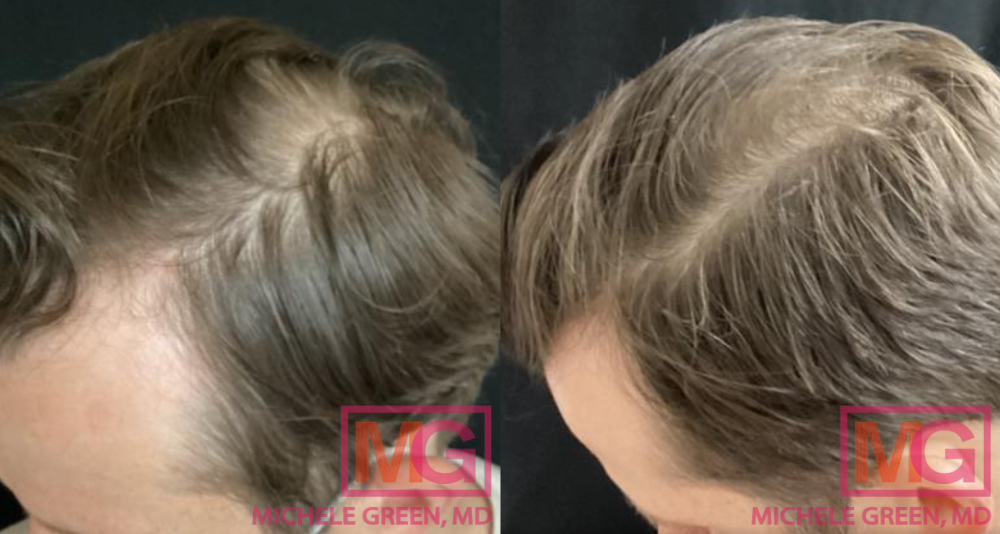
Ready to Talk Hair Loss Treatments? Contact Dr. Michele Green in NYC Today
Clascoterone is one of the most genuinely promising developments in hair loss treatment in more than three decades — a topical androgen receptor inhibitor that may eventually offer the DHT-blocking benefits of oral finasteride without the same systemic exposure. But “promising” and “approved” are two different things: Breezula is still working through the FDA process, with an NDA filing expected in early 2027 and approval realistically a couple of years away. In the meantime, proven options like finasteride, minoxidil, and other established hair loss treatments remain the most reliable path forward for patients experiencing male pattern hair loss or male pattern baldness today. Dr. Michele Green can help you determine which of those makes the most sense for your specific pattern of thinning.
Dr. Michele Green is an internationally recognized, board-certified dermatologist with decades of experience treating hair loss and scalp conditions on Manhattan’s Upper East Side. Castle Connolly, The New York Times, Super Doctors, and New York Magazine have named her one of New York’s best dermatologists. Whether you’re ready to start an established hair loss treatment today or want to understand how a future option like Breezula might fit into your plan, Dr. Green can walk you through the pros and cons of each approach based on your goals and hair loss pattern. To schedule a consultation with Dr. Michele Green, call her New York City office at 212-535-3088 or contact us online.


