


Dissolving Lip Filler: A Guide and Safety Considerations
Lip augmentation with dermal fillers is among the most popular cosmetic procedures for patients seeking a fuller pout, improved lip symmetry, and softer lines around the mouth. Thanks in part to the popularity of lip injections on social media, more patients than ever are pursuing this treatment. Yet, not every provider has the training to deliver safe, natural-looking results. When lip filler is placed by an inexperienced injector, patients can be left with overfilled lips, filler migration, lumps, or an uneven, asymmetrical shape. Fortunately, patients who are unhappy with a previous lip filler treatment have a safe and effective solution available at the New York City dermatology office of Dr. Michele Green: lip filler dissolution.
Lip filler dissolving uses a naturally occurring enzyme called hyaluronidase to safely break down hyaluronic acid-based dermal filler, allowing patients to reverse an unwanted result and start fresh. The treatment takes only 10 to 15 minutes, requires no downtime, and typically clears the treated hyaluronic acid filler from the injection site within about two weeks. Patients who wish to be re-injected with filler can generally do so about 14 days later. To find out whether lip filler dissolving is right for you, schedule a consultation with board-certified dermatologist Dr. Michele Green.
With over 25 years of experience, Dr. Michele Green is a board-certified dermatologist practicing on Manhattan’s Upper East Side. She is internationally recognized for her natural, less-is-more approach to cosmetic dermatology. She offers a full range of dermal fillers, including Juvéderm, Restylane, Sculptra, and Radiesse, allowing her to tailor each treatment plan to a patient’s unique anatomy and aesthetic goals. In addition to dermal fillers and lip filler dissolving, Dr. Green’s practice offers Botox, laser skin resurfacing, Kybella, and chemical peels, among other treatments. Dr. Green has been repeatedly named one of the best dermatologists in New York City by Castle Connolly, Super Doctors, and New York Magazine.
What are dermal fillers for the lips?
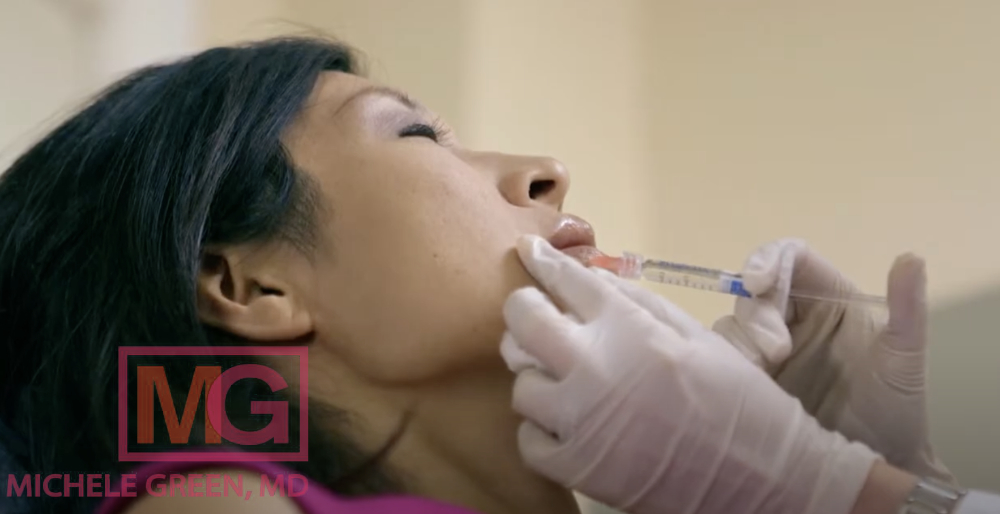
Dermal fillers are injectable treatments used to restore lost volume, soften fine lines, and enhance facial contours. They are commonly used in the lips, cheeks, under the eyes, and along the jawline. For the lips specifically, dermal filler is injected into and around the lip border to enhance shape, add volume, or smooth vertical lines around the mouth. Patients seeking a fuller, more dramatic pout often choose Juvéderm Ultra Plus, while Restylane Kysse is prized for its natural look, definition, and improved lip texture. For lines around the mouth, known as perioral lines, Dr. Green often uses Belotero Balance. For patients focused on overall facial volume rather than the lips alone, Sculptra, a filler made from poly-L-lactic acid that stimulates the body’s own collagen production, may be used elsewhere on the face. During your consultation, Dr. Green will discuss your goals and recommend the dermal filler best suited to your anatomy.
What is lip dissolving?
A frequent question when discussing whether lip filler is, “Are lip fillers reversible?” The most common active ingredient in lip fillers is hyaluronic acid, a naturally occurring molecule that binds water and adds hydration and volume to the skin. Because the enzyme hyaluronidase can break down hyaluronic acid, hyaluronic acid-based lip fillers are reversible, providing patients with an important safety net if they are unhappy with their results. It is most often sought by patients who are unhappy with a previous injector’s work, whether due to overfilling, filler migration, lumps, or an asymmetrical result. Because the treatment is quick, requires no downtime, and carries a strong safety profile, lip dissolving allows patients to correct an unwanted outcome and restore a more natural look before deciding on their next step. However, filler reversal is not possible for fillers that rely on other ingredients, such as poly-L-lactic acid or calcium hydroxylapatite, which is why Dr. Green reviews a patient’s full filler history before recommending a dissolving treatment plan.
What is hyaluronidase for dissolving lip filler?
Hyaluronidase is a naturally occurring enzyme that breaks down hyaluronic acid in the body. In its commercial, concentrated liquid form — such as Hylenex — it can be injected directly into an area treated with hyaluronic acid dermal filler to dissolve the gel and return the tissue to its pre-filler state. While hyaluronic acid filler will eventually break down on its own, the process can take anywhere from 6 to 18 months, which is a long time to live with an overfilled or asymmetrical result. Because it is derived from a substance the body already produces, hyaluronidase dissolving treatment is considered a safe and reliable option for patients who want to reverse hyaluronic acid filler.
But how does dissolving lip filler work? Hyaluronic acid is a humectant, meaning it draws in and holds moisture, which is why it is so effective at restoring lip volume and smoothing fine lines when used in dermal fillers. When a patient wants the filler removed, an injection of hyaluronidase introduces an enzyme that binds to hyaluronic acid molecules and breaks them apart, allowing the body to clear them naturally. The process is fast-acting, typically dissolving the treated filler within two weeks or less.
What is the lip filler dissolving procedure and aftercare?
Treatment begins with a consultation with a board-certified dermatologist, such as Dr. Green, who reviews your filler history and discusses your goals before recommending a treatment plan. Dr. Green also asks about any history of allergic reactions, particularly to bee venom, because patients with a bee allergy are not candidates for hyaluronidase and may need a patch test first. In the days leading up to treatment, patients are advised to avoid blood thinners, smoking, and alcohol. A topical numbing cream is often applied about an hour beforehand to minimize discomfort. The injections take no more than 15 minutes.
Afterward, mild swelling, bruising, or tenderness at the injection site is normal and typically resolves within a day or two. Dr. Green recommends avoiding extreme heat and strenuous exercise for the first 24 hours. She may schedule a follow-up visit to assess your results and determine whether a second hyaluronidase treatment is needed.
What to expect after dissolving lip filler
Hyaluronidase works quickly: most patients notice a visible reduction in filler volume within 24 to 48 hours after treatment. Immediately after treatment, it is normal to see mild swelling, redness, or bruising at the injection site, which can temporarily make the lips look slightly different from their eventual result. As this initial reaction subsides over the next day or two, the effects of hyaluronidase become more apparent, and the lips gradually return to their natural, pre-filler shape and volume over the next two weeks. Depending on the amount of filler being dissolved and its original placement, some patients need more than one session for complete correction. Dr. Green often schedules a follow-up appointment to check your progress. Final results are typically visible about two weeks after each treatment session.
Should I dissolve my lip filler?
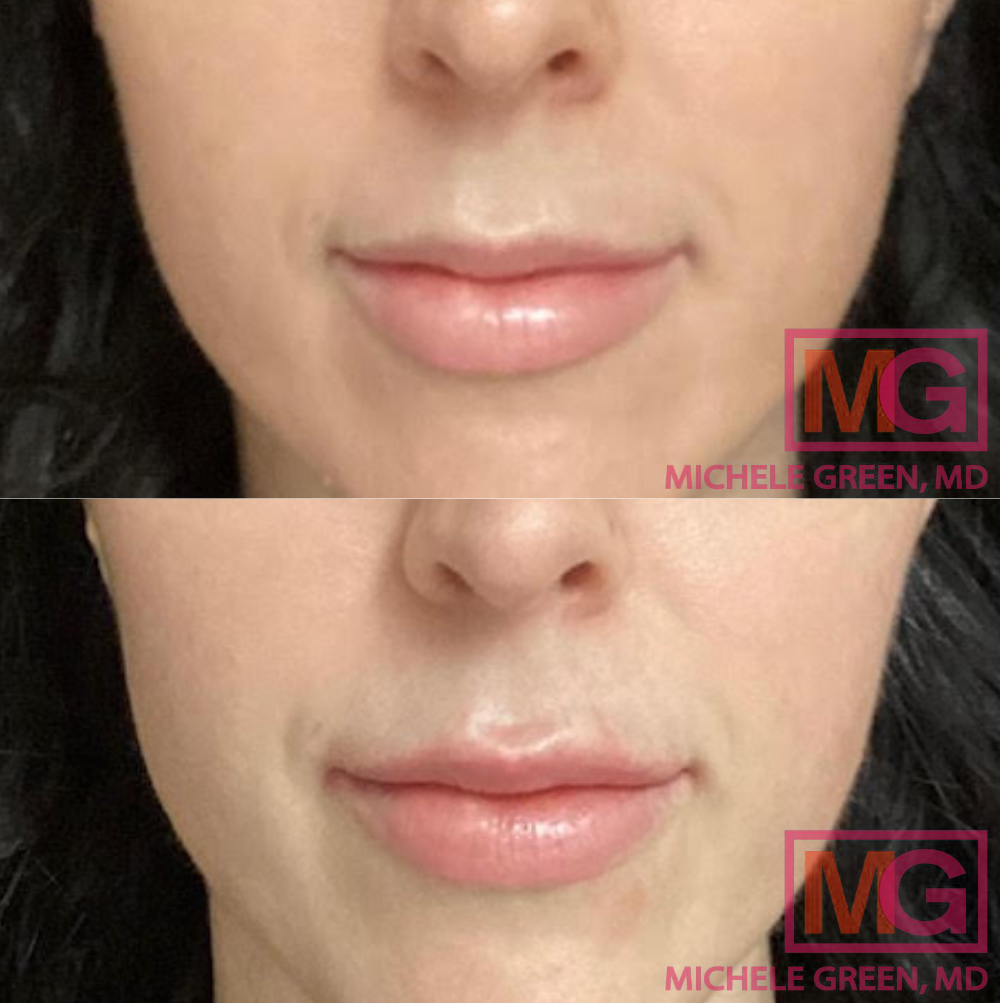
There are several reasons patients seek lip filler dissolution. Overfilling, which occurs when too much dermal filler is injected into the small surface area of the lips, can create an unnatural, exaggerated appearance that many patients want reversed. Improper placement by an inexperienced injector can also lead to filler migration beyond the intended treatment area or, in rare and more serious cases, vascular occlusion. Choosing an experienced, board-certified dermatologist like Dr. Michele Green from the start greatly reduces the risk of these outcomes, but for patients already unhappy with a previous result, dissolving offers a safe way to start over.
Safety of dissolving lip filler
Dissolving lip filler is considered a safe cosmetic procedure when performed by an experienced provider. Seeing a board-certified dermatologist who is qualified to dissolve lip filler is important because hyaluronidase must be dosed and injected with precision. Before treatment, Dr. Green screens patients for a history of allergic reactions, particularly to bee venom, because hyaluronidase should not be used in patients with a known bee allergy. She may perform a patch test if there is any uncertainty. Choosing a board-certified dermatologist with extensive injection experience, like Dr. Green, further reduces the already low risk of complications.
How much does dissolving lip filler cost?
The cost of dissolving lip filler varies based on several factors, including how much filler needs to be removed, how many treatment sessions are required, and the provider’s experience. While a medspa may advertise a lower price, it is far safer to have this cosmetic procedure performed by a board-certified dermatologist such as Dr. Michele Green, whose expertise reduces the risk of complications. Dr. Green’s office can provide an accurate cost estimate after your consultation, once she has recommended a treatment plan.
Frequently Asked Questions about Lip Filler Dissolving
Does lip dissolving work?
Yes. Hyaluronidase is highly effective at breaking down hyaluronic acid, and most patients see a noticeable reduction in filler volume within 24 to 48 hours, with full results by about two weeks. Because it targets hyaluronic acid specifically, the enzyme leaves surrounding tissue undisturbed, allowing the lips to settle back into their natural shape. Patients with a larger volume of filler to remove, or filler that has been in place for a long time, may need more than one session to achieve complete correction.
Do lip fillers dissolve on their own over time?
Lip fillers are not permanent. Left untreated, most hyaluronic acid-based dermal fillers are naturally broken down by the body over 12 to 18 months, after which the lips gradually return to their pre-filler appearance. The exact timeline depends on the type and amount of filler used, as well as each patient’s individual metabolism. Patients who would prefer not to wait can achieve the same result much faster with a hyaluronidase dissolving treatment.
Does dissolving lip filler hurt?
As with any injectable treatment, lip filler dissolving can cause some discomfort during and shortly after the appointment. Dr. Green typically applies a topical numbing cream beforehand to keep patients comfortable. Any post-treatment tenderness, redness, swelling, or bruising at the injection site is generally mild and short-lived. Icing the area and keeping the head elevated while sleeping can help minimize discomfort in the days that follow.
Do lips go back to normal after dissolving?
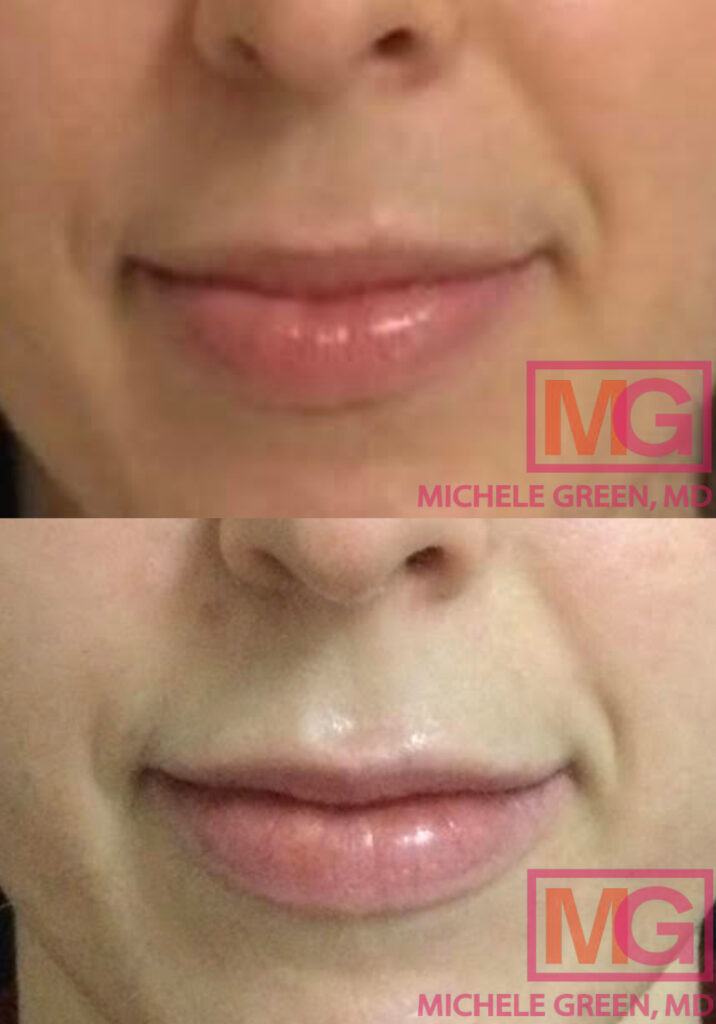
Yes. Because hyaluronidase specifically targets hyaluronic acid rather than the surrounding lip tissue, the lips return to their natural pre-filler size and shape once the enzyme has fully broken down the dermal filler. Most patients see this natural look restored within about two weeks of treatment, at which point they can decide whether to leave their lips as they are or pursue filler again.
Can Botox be used around the lips instead of dermal fillers?
Botox and dermal fillers are both popular injectables, but they work differently and serve different purposes. Botox contains onabotulinumtoxinA, which temporarily relaxes the small muscles responsible for dynamic wrinkles, such as the vertical lip lines that form with repeated pursing of the mouth. Dermal fillers add volume and structure. The two are often used together, since Botox can also be used to perform a lip flip — softening the muscles around the mouth so the upper lip curls slightly outward for a fuller appearance without any added filler volume.
What is filler migration and can dissolving fix it?
Filler migration occurs when dermal filler moves away from its original injection site, often resulting in lumps, an uneven contour, or a puffy appearance above the lip border. It is more common when filler is injected too superficially or in excessive volume by an inexperienced injector. Because migrated filler is still hyaluronic acid-based, it typically responds well to hyaluronidase, which dissolves the misplaced filler and allows the lips to return to a smoother, more natural look.
Can you dissolve just some of the filler or fix asymmetry?
Hyaluronidase treatment does not have to be all-or-nothing. Dr. Green can inject small, targeted amounts of the enzyme into specific areas of asymmetry or overfilling, dissolving only the filler causing the unwanted result while preserving filler elsewhere in the lips. This precise, conservative approach is especially useful for correcting a lopsided outcome without starting from scratch.
When should I dissolve my lip filler?
If you are unhappy with your results, it is best to schedule a dissolution appointment sooner rather than later, since filler can gradually integrate with surrounding tissue over time, making it more difficult to remove completely. That said, Dr. Green generally recommends waiting at least one month after the original filler injections so that any initial swelling has resolved and the final result can be properly assessed.
When do lip fillers start to dissolve?
Without a dissolving treatment, hyaluronic acid-based lip filler gradually breaks down, with most formulations fully resolving within 12 to 18 months. As the body metabolizes the filler, patients will notice a slight, steady decrease in lip volume rather than a sudden change. Dr. Green typically recommends follow-up filler appointments every 6 months to a year for patients who want to maintain consistent results.

How long does dissolving lip filler take?
A lip filler-dissolving treatment clears hyaluronic acid filler from the injection site in about 14 days. The exact timeline can depend on the type and amount of filler used, since different hyaluronic acid formulations are cross-linked to varying degrees of firmness. Firmer fillers can be more resistant to breakdown and may require additional sessions. As a general guideline, Dr. Green uses approximately five units of hyaluronidase for every 0.1 mL of a 20 mg/mL hyaluronic acid filler.
Do lip fillers dissolve completely?
Whether a lip filler dissolves completely depends on the type and volume of the original filler. Hyaluronic acid-based fillers are the only type that responds to hyaluronidase, and in most cases the enzyme fully dissolves the treated filler. However, some patients with larger volumes may need more than one session to achieve a completely natural look.
Why is my lip filler not dissolving?
If a lip filler does not respond to hyaluronidase, it is likely the original filler was not hyaluronic acid-based. Fillers made from other materials cannot be reversed with hyaluronidase, though they will still break down naturally over time, typically within 12 to 24 months. Patients who are unsure which filler they received, or who want to avoid this uncertainty altogether, should seek treatment from an experienced injector such as Dr. Green, who takes a less-is-more approach to protect a natural look from the start.
Is dissolving lip filler painful?
As with any injectable treatment, some discomfort is normal, though a topical numbing cream applied about an hour before treatment helps keep patients comfortable throughout. Afterward, patients may notice mild tenderness, redness, swelling, or bruising at the injection site, all of which typically resolve within a day or two.
Does dissolving lip filler cause wrinkles?
Hyaluronidase treatment is not associated with any lasting increase in fine lines or skin laxity. In some cases, the enzyme may temporarily break down a small amount of the body’s own hyaluronic acid, in addition to the filler, which can lead to subtle, short-term thinning or fine lines. This effect resolves on its own as the body replenishes its hyaluronic acid stores.
Will dissolving make my lips saggy, smaller, or ruin them?
No. Hyaluronidase is designed to target only hyaluronic acid, so it does not damage the lip tissue or leave the lips permanently saggy or misshapen. Once the treated filler has fully dissolved, the lips return to their natural, pre-filler size and shape rather than an altered or diminished one. Patients are free to pursue new filler afterward if they choose.
Does dissolving lip filler cause swelling?
Mild swelling, along with redness and bruising at the injection site, is a common and expected side effect of any injectable treatment, including hyaluronidase. In the week before treatment, Dr. Green advises patients to avoid blood-thinning medications and supplements, which can increase the risk of bruising or swelling. These effects are temporary and typically resolve within one to two days.
When can I get new filler after dissolving?
Because hyaluronidase takes about two weeks to fully clear hyaluronic acid filler from the treated area, Dr. Green recommends waiting at least 14 days before receiving new dermal filler. Many patients who dissolve a previous, unsatisfactory result return to Dr. Green for their next treatment because her less-is-more philosophy is designed to deliver a natural look the first time.

Get Started With Dissolving Your Lip Filler Today
Lip augmentation with dermal filler remains one of the most popular cosmetic procedures for enhancing lip volume and symmetry. Still, when performed by an inexperienced injector, it can leave patients with overfilling, filler migration, or asymmetry they never intended. Lip filler dissolving offers a safe, fast-acting solution: a hyaluronidase injection breaks down unwanted hyaluronic acid-based filler in about two weeks, allowing patients to correct an unsatisfactory result and restore a natural look. If you are considering dissolving lip filler, Dr. Michele Green can help you understand your options and build a treatment plan tailored to your goals.
Dr. Michele Green is a board-certified dermatologist in New York City with over 25 years of experience and a well-known, less-is-more approach to cosmetic treatment. She has been repeatedly recognized by Castle Connolly, Super Doctors, and New York Magazine as one of the top dermatologists in New York. Patients travel from across the country and abroad to benefit from her expertise in dermal fillers, lip filler dissolving, and a full range of injectable treatments. To schedule a consultation with Dr. Green and determine which lip filler or dissolving treatment is right for you, please call our office today at 212-535-3088 or contsct us online.


