


How Do I Know My Fitzpatrick Skin Type?
The Fitzpatrick skin type scale was developed in 1975 to classify patients by their UV sensitivity, with the goal of determining the appropriate UVA dose for phototherapy. Since then, the scale has been used across dermatology to assess the safety and effectiveness of treatments such as laser therapy and chemical peels. Certain types of lasers and higher-depth chemical peels can damage the skin of patients with darker skin tones, leading to hyperpigmentation, hypopigmentation, and permanent scarring. As a result, it is essential to seek out a dermatologist who is familiar with safe, effective treatments for each skin type, such as expert dermatologist Dr. Michele Green.
When determining a patient’s Fitzpatrick skin type, the test asks patients to self-identify based on skin color, hair color, eye color, the likelihood of sunburn, and the likelihood of tanning after sun exposure. By combining skin color and sun sensitivity, the Fitzpatrick skin type test is a simple, standardized method for measuring UV light sensitivity. While the test also aimed to identify patients at higher risk of developing skin cancer, it is important to note that all patients, regardless of skin type or tone, are at risk, even if they do not burn in the sun. To find out more about skincare routines, in-office treatments, and skin cancer screening for your skin type, schedule an initial consultation with experienced dermatologist, Dr. Michele Green.
Board-certified dermatologist Dr. Michele Green has been expertly treating patients of all skin types and skin tones at her Upper East Side, New York City dermatology office for more than 25 years. Experienced in a wide range of treatment options, Dr. Green knows which laser treatments and chemical peels are safe for patients with darker skin tones and which need to be avoided. In addition to treating all forms of hyperpigmentation, including melasma, sun spots, acne scars, and rosacea, Dr. Green is an expert in skin rejuvenation, offering treatments such as Botox, dermal fillers, skin tightening, and more. Well-known for high patient satisfaction, Dr. Green has been voted one of the best dermatologists in New York City by such publications as Castle Connolly, Super Doctors, and New York Magazine.
What are the six Fitzpatrick skin types?
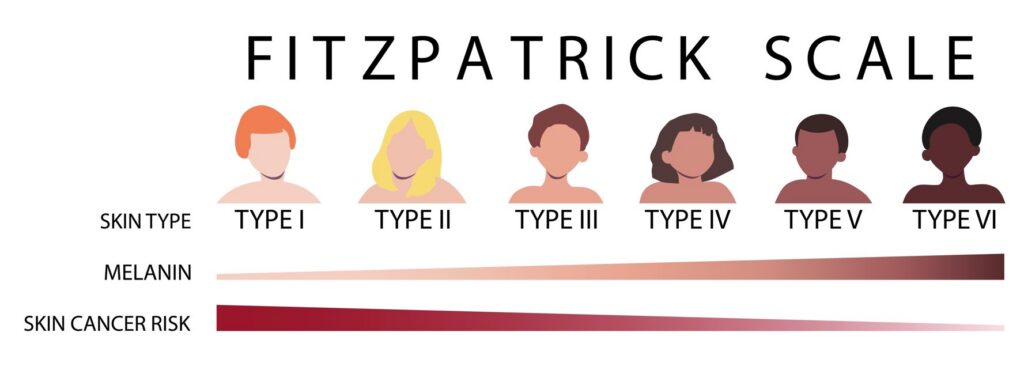
The Fitzpatrick skin scale recognizes six distinct skin phototypes based on melanin concentration and how the skin reacts to sun exposure, including the likelihood of burning versus tanning. The six categories are described in greater detail below.
What is Fitzpatrick skin type I?
Fitzpatrick skin type I is characterized by pale skin, light blonde or red hair, and blue or green eyes. Patients with Fitzpatrick skin type I are highly prone to sunburn, and sun exposure will lead to significant redness, blistering, and peeling. Patients with Fitzpatrick type I skin tone typically do not tan, but will often have many freckles.
What is Fitzpatrick skin type II?
Fitzpatrick skin type II is characterized by fair skin, blonde hair, and green or blue eyes. Patients with Fitzpatrick skin type II will always burn without sun protection, may have freckles, and have difficulty tanning.
What is Fitzpatrick skin type III?
Fitzpatrick skin type III is characterized by fair or olive skin, dark blonde or brown hair, and dark blue or light brown eyes. Patients with Fitzpatrick skin type III typically develop burns after unprotected sun exposure, but the burns often fade into a tan. Patients with Fitzpatrick skin type III may experience pigmentation on the skin’s surface in the form of freckles.
What is Fitzpatrick skin type IV?
Fitzpatrick skin type IV is characterized by medium brown skin, brown hair, and brown eyes. Patients with Fitzpatrick skin type IV typically do not burn and usually tan after sun exposure. Patients with Fitzpatrick skin type IV do not typically have freckles.
What is Fitzpatrick skin type V?
Fitzpatrick skin type V is characterized by darker skin, brown or black hair, and dark brown eyes. Patients with Fitzpatrick skin type V burn very rarely and tan very easily. Patients with Fitzpatrick skin type V are more susceptible to hyperpigmentation after laser treatments or scarring.
What is Fitzpatrick skin type VI?
Fitzpatrick skin type VI is characterized by black skin, black hair, and dark brown or black eyes. Patients with Fitzpatrick skin type VI never burn and often tan after sun exposure. Similar to patients with Fitzpatrick skin type V, patients with Fitzpatrick skin type VI are more susceptible to hyperpigmentation after certain laser treatments or scarring.
How does the Fitzpatrick scale work?
The Fitzpatrick skin type scale was developed to measure how a patient’s skin reacts to ultraviolet (UV) light based on the concentration of the pigment melanin found in the skin. The amount of melanin present in the skin determines each person’s natural skin color: lower concentrations contribute to lighter skin, while higher concentrations contribute to darker skin tones. The Fitzpatrick scale takes skin color and sun reaction into account, asking patients to report their likelihood of burning or tanning. Typically, patients on the low end of the Fitzpatrick scale (types I-III) are more likely to burn and less likely to tan, while patients on the high end of the scale (types IV-VI) are less likely to burn and more likely to tan. The Fitzpatrick scale is commonly used in dermatology to assess skin cancer risk and the risk of hyperpigmentation and scarring after laser treatment. It is important to note, however, that skin cancer can affect patients of all skin tones.
Who developed the Fitzpatrick scale?
The Fitzpatrick scale was developed by Harvard dermatologist Dr. Thomas B. Fitzpatrick in 1975. Dr. Fitzpatrick began developing the scale in 1973 while studying the effects of sun exposure on Australians with fair skin. As part of his research, he categorized the population into three sub-sections:
I. People who do not tan at all and sunburn easily
II. People who tan with difficulty and sunburn easily
III. People who tan fairly easily and may sunburn moderately
Later, in 1975, he recognized the need to measure skin tone to administer the optimal initial UVA dose for phototherapy in fair-skinned individuals with skin conditions such as vitiligo, eczema, and psoriasis. Dr. Fitzpatrick realized that simply looking at skin color was not sufficient to determine the correct dosage; instead, he needed to measure how the skin reacted to sun exposure. Since its development in 1975, the Fitzpatrick scale has been widely used in dermatology.
What is the history of the Fitzpatrick scale?
The Fitzpatrick scale was developed in 1975 by Harvard researcher Thomas B. Fitzpatrick to assess an individual’s response to UV light for phototherapy. Until the 1960s, phototype—also known as skin type—was determined solely by examining a patient’s skin, hair, and eye colors. However, this classification did not assess the skin’s response to sun exposure, so it was ineffective for determining UV dosage in phototherapies. Dr. Fitzpatrick created a classification system based on the appearance of the skin and a brief personal interview in which patients characterized how their skin reacted to sun exposure without sunscreen. The initial Fitzpatrick scale was determined using white-skinned individuals and consequently had only four categories—types I-IV. Later, types V and VI were added to include patients with darker skin tones. However, these categories were largely based on perceived skin color rather than on how the skin reacts to the sun.
What are the limitations of the Fitzpatrick scale?
While the Fitzpatrick scale is often cited in dermatology, it has several limitations and is subject to valid criticisms. The major critique of the Fitzpatrick scale is that it was developed based on patients with white and fair skin tones, thereby failing to account for the vast diversity of darker skin tones. The scale initially included only types I-IV for lighter skin types, and when types V and VI were added, the category was based solely on skin color rather than on the skin’s reaction to sun exposure. Studies have shown that fair-skinned individuals of European descent exhibit the narrowest range of skin color variation, whereas those with darker skin tones exhibit a much wider range. Additionally, the Fitzpatrick scale relies largely on self-reporting of skin color, sunburn, and tanning tendencies, which overlooks the many nuances of each individual’s skin tone and experience.
Is the Fitzpatrick skin type outdated?
The Fitzpatrick skin type scale was developed as a simple method for determining the skin’s UV sensitivity prior to UV phototherapy. While there is an objective test to determine the skin’s UV sensitivity, the minimal erythema dose (MED) calculation, it is time-consuming and requires equipment that is not widely available. As such, the Fitzpatrick scale, though a much more subjective measuring system, became the standard. These days, researchers are more closely examining the effectiveness of the Fitzpatrick scale in actually determining patients’ UV sensitivity. Some studies have found no significant correlation between a patient’s Fitzpatrick skin type, as determined by self-report of sunburns and tanning, and their actual UV sensitivity. Additionally, the Fitzpatrick skin type scale was developed based on responses from the lighter-skinned population, so it may not adequately categorize patients with darker skin tones.
Does the risk associated with sun exposure vary by natural skin color? Is light brown skin more at risk of sun damage than dark brown skin?
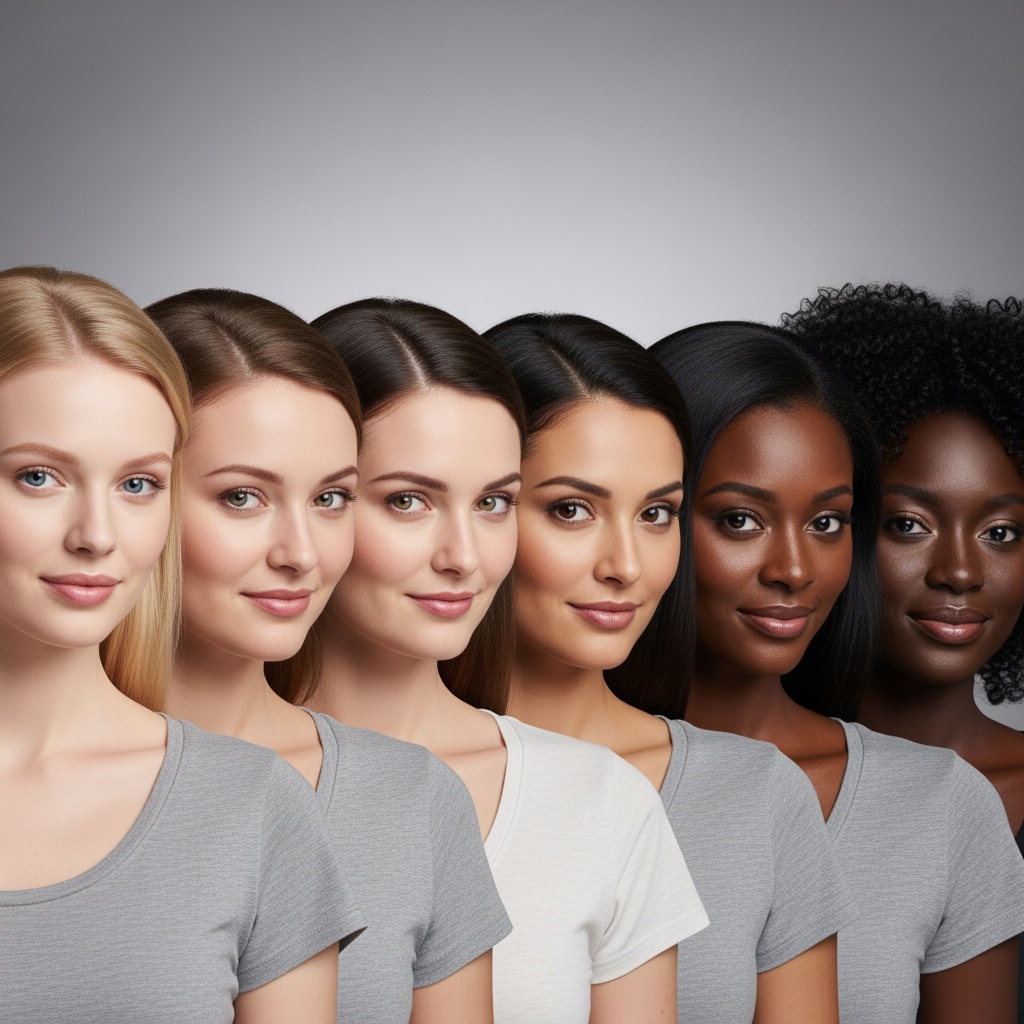
All patients, regardless of skin tone and Fitzpatrick skin type, can be at risk of sun damage when exposed to the sun’s harmful UV rays without sunscreen. As such, Dr. Green recommends that all patients apply sunscreen with SPF 30 or higher every morning as a part of their regular skincare routine. When the sun is at its most intense—between 10 am and 4 pm—patients should practice strict sun avoidance by seeking shade, staying out of direct sunlight, and reapplying sunscreen every 2 hours or after excessive sweating or swimming.
Which Fitzpatrick skin type is at the highest risk of skin cancer?
Patients of all skin colors and Fitzpatrick skin types can develop skin cancer, regardless of whether they are more susceptible to sunburn. Patients with lighter skin tones are typically at higher risk of developing basal cell carcinoma, squamous cell carcinoma, and melanoma in areas exposed to the sun’s UV rays without protection. Patients with darker skin tones are more prone to developing acral lentiginous melanoma, which is a dangerous form of skin cancer that develops in unexposed areas. Because these cancerous lesions are often out of sight, they are more likely to spread before they are discovered, so it is very important to perform full-body checks for unusual lesions. According to studies performed in 2020, skincare professionals who do not identify as People of Color are less likely to provide education and resources about skin cancer to their Patients of Color, even though skin cancer affects 4.5 million People of Color every year. Board-certified dermatologist Dr. Green treats patients of all skin tones and types, providing each patient with the information and care they need.
What is the most common Fitzpatrick skin type?
While the Fitzpatrick skin type scale remains widely used in dermatology, it does not fully capture the range and diversity of skin tones, especially among Patients of Color. The Fitzpatrick scale was developed for fair-skinned patients, which means it overemphasizes differences in skin tone among lighter-skinned patients while failing to account for the nuances of skin tone and UV sensitivity in darker-skinned patients. As a result, the “most common” Fitzpatrick skin type may not accurately represent the population.
Do eye color, hair color, and freckles have any bearing on the classification system?
The standard Fitzpatrick skin type test asks patients to classify their hair and eye color and the concentration of freckles. Each of these areas is assigned a numerical value: lower numbers are associated with blue or green eyes, light hair, and more freckles, while higher numbers are associated with brown eyes, dark hair, and fewer freckles. Eye color, hair color, skin color, and freckles are only part of the Fitzpatrick classification system and may help categorize skin undertones. To determine UV sensitivity, patients are asked about how likely they are to burn and to tan.
What is the dermatologist-recommended skin care for each skin type?
Regardless of skin tone or type, Dr. Green recommends that all patients practice a consistent skincare routine that always includes sunscreen with SPF 30 or higher. Patients should start their day with a gentle cleanser, moisturizer, and sunscreen to ensure the face is clean, hydrated, and protected from harmful sun exposure. Some patients may benefit from vitamin C serum or retinol to keep the skin clear and smooth, and to prevent early signs of the natural aging process. At Dr. Green’s New York City dermatology office, many in-office treatments are available, including laser therapies, chemical peels, microneedling, dermal fillers, and more. During your initial consultation with Dr. Green, she will help you determine the skincare routine that will be most effective for you.

What is true of individuals with Fitzpatrick skin types 1, 2, 3, 4, 5, & 6?
The Fitzpatrick skin type scale categorizes individuals based on their skin tone and UV sensitivity. The characteristics of each Fitzpatrick skin type are as follows:
Type I:
- Fair skin
- Blue or green eyes
- Red or light blonde hair
- Burns easily without tanning
Type II:
- Fair skin
- Blue or green eyes
- Blonde hair
- Burns easily and tans with difficulty
Type III:
- Fair skin
- Blue or brown eyes
- Blonde or light brown hair
- Burns moderately and tans sometimes
Type IV:
- Brown skin
- Brown eyes
- Brown hair
- Burns rarely and tans more than average
Type V:
- Dark brown skin
- Brown eyes
- Brown or black hair
- Burns very rarely and tans easily
Type VI:
- Black skin
- Brown or black eyes
- Black hair
- Never burns
- Tans easily
How to find out your Fitzpatrick skin type classification today
The Fitzpatrick skin type classification system is widely used in dermatology to assess patients’ sensitivity to UV light for phototherapy. It can be a useful technique for determining whether certain laser treatments, chemical peels, and creams to address hyperpigmentation are safe and effective. However, the Fitzpatrick scale has limitations, and a patient’s classification may bias inexperienced dermatologists—especially when educating patients about the risks of skin cancer. That is why it is essential to seek treatment from an expert dermatologist with years of experience treating patients of all skin types, such as Dr. Michele Green. Dr. Green provides each patient with an individualized treatment plan to safely and effectively achieve their aesthetic goals.
Dr. Michele Green is an internationally renowned board-certified dermatologist with over 25 years of experience providing her patients with the best non-invasive treatment options. Dr. Green takes a holistic approach and embraces a less-is-more philosophy, creating customized skincare routines and treatment plans tailored to her patients’ unique concerns and aesthetic goals. She is consistently recognized by Castle Connolly, New York Magazine, and Super Doctors as one of New York’s best dermatologists for her dedication to her patients and expertise. Please call us at 212-535-3088 or email our New York City-based office today to schedule a consultation with Dr. Michele Green and find out your Fitzpatrick skin type today.


